Most likely to keep biting flies away. Horseflies circle and touch zebras about as often as plain horses, with no clear difference, but far fewer of them manage to land3. Exactly how stripes put the flies off is not settled, and some scientists think temperature plays a role too7, 10.
The prime suspect: biting flies
Scientists have puzzled over the zebra's coat for over 150 years4. In 2014, a team led by biologist Tim Caro compared the stripes of zebras, horses and asses with where those animals live1, 2. Stripes went with places whose climate suits biting flies1, 2. The number of belly stripes also matched where tsetse flies occur1. Camouflage, avoiding predators, managing heat and social life found no consistent support1.
Why would flies matter so much? In Africa, horseflies can spread diseases that can be fatal to zebras, such as trypanosomiasis3. Zebra hair is also shorter than a biting fly's mouthparts, so flies can reach the skin easily2, 3.
In a study published in 2019, researchers filmed horseflies around captive zebras and horses on a farm in England3, 4. Flies circled and briefly touched both animals with no clear difference, but far fewer of them landed on zebras3, 4. They came in fast and did not slow down, and a fly has to slow down to land3, 4. In only five recorded landings on zebras, flies stayed 1.20 seconds on average, versus 10.06 seconds on horses. The authors put this down to the zebras' behavior, not their stripes3.
How stripes trip up a fly
In a second test, the same horses took turns wearing black, white and striped coats3, 4. In the striped coat they got far fewer touches and landings, yet flies landed on their bare heads just as often3. So the pattern itself makes the difference, not the animal's smell or behavior3, 4. Earlier, a striped model horse attracted far fewer horseflies than plain-colored ones, and in tests with striped patterns, narrower stripes attracted fewer flies5.
Exactly why the flies fail is still not settled3, 7. One idea was the 'aperture effect', where straight edges create false signals of movement6. But flies avoided checked rugs about as much as striped ones, and that ruled the idea out6. Another idea was polarized light, because light and dark stripes reflect light polarized in very different ways5. Yet a 2023 study found no evidence that horseflies are drawn to coats that reflect more polarized light7. The authors' working hypothesis: thin, sharp stripes leave no large dark patches, and horseflies are drawn to such patches at close range7.
What about lions and heat?
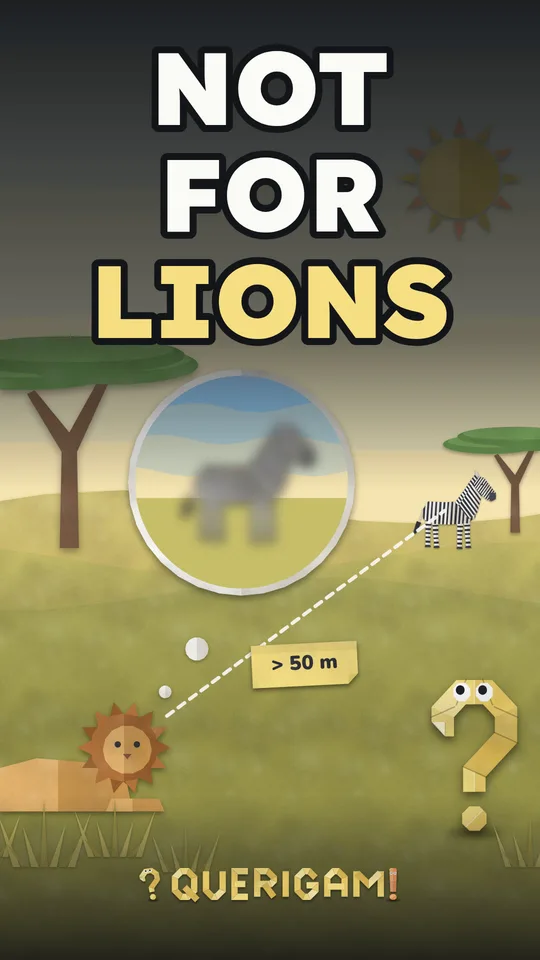
Camouflage looks unlikely. Estimates of how lions and hyenas see suggest that zebra stripes are hard for them to make out beyond about 50 meters in daylight, or 30 meters at twilight8. From farther away, a zebra simply looks gray8. Zebras see stripes better than their predators do, but the authors doubt zebras need them to recognize each other, since horses manage without8.
Heat is hotly debated. Across 16 sites where plains zebras live, temperature predicted a lot of the variation in their stripes, and that study found no evidence for the biting-fly idea9. But when scientists wrapped water-filled barrels in hides, the inside of the striped barrels was no cooler than the inside of the gray ones11. A study of two zebras in Kenya measured black stripes 12–15 °C hotter than white ones and proposed that small air currents above the stripes help cool the animal12. A 2021 lab test found that such air currents get blown away by the weakest wind13.
What we're not sure about
How stripes stop flies: several proposed mechanisms, like the aperture effect and polarized light, found no support, and the leading idea is only a working hypothesis6, 7.
Flies or heat? The rival team notes that the 2014 study used temperature and humidity as a stand-in for horsefly numbers, and that neither study counted horseflies10.
Maybe both: the same team suggests a role for heat, biting flies or both10.
The key fly experiments took place at one horse livery in Somerset, England, with horses and three captive zebras, not on the African savanna3, 6.
Sources
- Caro T, Izzo A, Reiner RC, Walker H, Stankowich T (2014): The function of zebra stripes. Nature Communications 5:3535
- University of California, Davis (2014): Scientists solve the riddle of zebras' stripes. Press release via EurekAlert!
- Caro T, Argueta Y, Briolat ES, Bruggink J, Kasprowsky M, Lake J, Mitchell MJ, Richardson S, How M (2019): Benefits of zebra stripes: Behaviour of tabanid flies around zebras and horses. PLOS ONE 14(2):e0210831
- University of Bristol (2019): Zebra stripes. News release, February 2019
- Egri A, Blahó M, Kriska G, Farkas R, Gyurkovszky M, Åkesson S, Horváth G (2012): Polarotactic tabanids find striped patterns with brightness and/or polarization modulation least attractive: an advantage of zebra stripes. Journal of Experimental Biology 215(5):736–745
- How MJ, Gonzales D, Irwin A, Caro T (2020): Zebra stripes, tabanid biting flies and the aperture effect. Proceedings of the Royal Society B 287:20201521
- Caro T, Fogg E, Stephens-Collins T, Santon M, How MJ (2023): Why don't horseflies land on zebras? Journal of Experimental Biology 226(4):jeb244778
- Melin AD, Kline DW, Hiramatsu C, Caro T (2016): Zebra Stripes through the Eyes of Their Predators, Zebras, and Humans. PLOS ONE 11(1):e0145679
- Larison B, Harrigan RJ, Thomassen HA, Rubenstein DI, Chan-Golston AM, Li E, Smith TB (2015): How the zebra got its stripes: a problem with too many solutions. Royal Society Open Science 2:140452
- Larison B, Harrigan RJ, Rubenstein DI, Smith TB (2015): Concordance on zebra stripes is not black and white: response to comment by Caro & Stankowich (2015). Royal Society Open Science 2:150359
- Horváth G, Pereszlényi Á, Száz D, Barta A, Jánosi IM, Gerics B, Åkesson S (2018): Experimental evidence that stripes do not cool zebras. Scientific Reports 8:9351
- Phys.org (2019): Zebras' stripes could be used to control their temperature, reveals new study (on Cobb A, Cobb S (2019), Journal of Natural History 53:863–879)
- Pereszlényi Á, Száz D, Jánosi IM, Horváth G (2021): A new argument against cooling by convective air eddies formed above sunlit zebra stripes. Scientific Reports 11:15797
Researched and independently fact-checked on 23 October 2026. Found a mistake? Tell us at querigami@gmail.com and we will correct it here.
Even careful research can contain errors, and science keeps moving. This article is for general information and education only, not professional advice. We link to sources so you can check them yourself, but we are not responsible for the content of external websites.