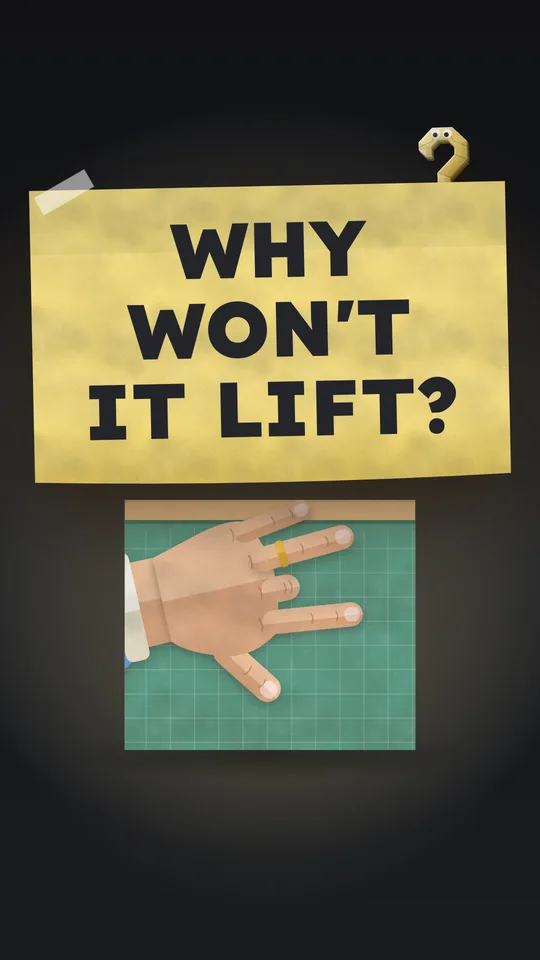
Your ring finger has no lifting muscle of its own. It shares one with three other fingers, and small bands on the back of your hand tie its tendon to the tendons beside it. When the middle finger is folded under, those links hold the ring finger back. The brain adds to this, because signals meant for one finger also reach its neighbours.
Try it yourself
Put your hand flat on a table. Fold your middle finger under, so its knuckle rests on the table. Now lift your thumb, then your index finger, then your little finger. Each one goes up easily. Now try your ring finger. For many people it stays stuck, or rises only a tiny bit.
We found no study that measured this exact table trick. But scientists have studied the parts that cause it.
One muscle, four fingers
The main muscle that straightens your fingers sits in your forearm. In almost everyone, it sends tendons to the index, middle, ring and little fingers9, 10. The index finger has a second lifting muscle of its own, which lets it straighten apart from the others9. The little finger has its own extra lifter too7, 9. Its tendon from the main muscle is often missing, and the ring finger's tendon often sends it a branch instead7. The ring finger gets only its share of the main muscle7, 9. In some hands that share is doubled into two tendons, but they still come from the same muscle7.
Bands that tie the tendons
On the back of your hand, small cross-bands called juncturae tendinum link the finger tendons11. In a study of 40 hands, every hand had bands between the middle and ring fingers, and between the ring and little fingers5. Their shape varied: thin threads, thicker bands, or slips5. Between the ring and little fingers, the slip type (whole slips of tendon) showed up in 80% of hands5. The index finger's private tendon had no band at all5, 12.
Hand anatomists write that these bands limit how far one finger can straighten on its own15.
Why the folded finger holds it back
When a knuckle bends, the lifting tendon over it slides toward the fingertip8. So the band joining the middle tendon to the ring tendon11 can pull the ring finger's tendon toward the fingertip too. This is our reading of the anatomy; no study has measured it in the table trick. A hand surgery textbook says the bands restrict the ring and middle fingers from straightening alone when the other fingers are bent at the knuckle7, 16.
Tests on donated hands show how strong such links are. Pulling only the main muscle's tendon to the index finger also straightened the middle finger's knuckle to 32% of its full range6. After the bands and the thin tissue between the tendons were cut, this fell to 22%6. Only when the skin between the fingers was cut as well did it drop to 5%6. So the bands are only part of what links the fingers.
The brain plays a part too
Even off the table, fingers rarely move fully alone. When people tried to move one finger, other fingers moved too1. The ring finger scored lowest: about 0.91 on a scale where 1.0 means perfectly alone, compared with 0.98 for the thumb, measured on the right hands of 10 people1. Another study found that no finger can bend through its whole range alone. On average, fingers moved only 13% to 61% of their range before a neighbour joined in3.
Part of this comes from the nervous system. Signals meant for one finger's muscles also reach the muscles of other fingers1, 4. One study compared fingers moved by a machine while people relaxed with fingers they moved on purpose. It concluded that the mechanical links are a major limit, especially for the index, middle and ring fingers, and that in big movements the nervous system's control adds a limit for the ring and little fingers2. A newer study tired out the ring finger first. Its unwanted pushing force went down, but its unwanted movement did not4. The authors think the brain matters more for force, and the mechanical links matter more for movement4.
Isn't it just weak?
Some piano teaching pages call the ring finger the weakest finger and say training can make it more independent13. The lab studies we read measured something else: how well each finger moves alone. By that measure, the ring finger came last in one study1, and in another it was the finger most often dragged along when its neighbours moved3.
In grip strength, the ring finger is not the odd one out. One study found that the index, middle, ring and little fingers gave about 25%, 35%, 25% and 14% of the grip force17.
What we're not sure about
No study we found measured the table trick itself. The explanation here is pieced together from anatomy and finger-movement studies.
How much comes from the bands and how much from the brain is still argued. One study calls the mechanical links a major limit2, while a newer one says the answer depends on the task4.
The studies do not agree on every finger. One found the little finger the most independent, but a later study could not repeat that3.
The bands differ a lot from hand to hand5. Whether people with thinner bands can lift the ring finger in the table trick has not, as far as we know, been tested. That is our guess, not a finding.
The bending tendons on the palm side are linked as well14. How much they add to the table trick is unclear.
Sources
- Häger-Ross C, Schieber MH, 2000, Quantifying the independence of human finger movements: comparisons of digits, hands, and movement frequencies, Journal of Neuroscience 20(22):8542-8550
- Lang CE, Schieber MH, 2004, Human finger independence: limitations due to passive mechanical coupling versus active neuromuscular control, Journal of Neurophysiology 92(5):2802-2810 (abstract only)
- van den Noort JC, van Beek N, van der Kraan T, Veeger DHEJ, Stegeman DF, Veltink PH, Maas H, 2016, Variable and asymmetric range of enslaving: fingers can act independently over small range of flexion, PLoS ONE 11(12):e0168636
- Mulla DM, Tilley PM, Keir PJ, 2025 (preprint; journal version Human Movement Science 2026), Unravelling neuromechanical constraints to finger independence, bioRxiv
- von Schroeder HP, Botte MJ, Gellman H, 1990, Anatomy of the juncturae tendinum of the hand, Journal of Hand Surgery (Am) 15(4):595-602 (abstract only)
- von Schroeder HP, Botte MJ, 1993, The functional significance of the long extensors and juncturae tendinum in finger extension, Journal of Hand Surgery (Am) (abstract only)
- Green's Operative Hand Surgery, chapter Extensor Tendon Injury (Elsevier), as mirrored on Musculoskeletal Key, 2018
- Kamiya M, Sasaki G, Ikuta K, Miyamoto H, Kimura M, Kawano H, 2020, Extensor tendon dislocation at the metacarpophalangeal joint of both ring fingers caused by a specific hand posture in a shiatsu therapist, Case Reports in Orthopedics 2020:6842986
- Boundless / LumenLearning, 2025 (last modified), 9.9B Muscles of the Wrist and Hand, Anatomy and Physiology (Boundless), Medicine LibreTexts, CC BY-SA 4.0
- Wikipedia contributors, Extensor digitorum muscle, Wikipedia (accessed 2026-11-20)
- Wikipedia contributors, Juncturae tendinum, Wikipedia (accessed 2026-11-20)
- von Schroeder HP, Botte MJ, 1997, Functional anatomy of the extensor tendons of the digits, Hand Clinics (abstract only)
- Piano teaching blog, 18 Piano Exercises for Weak Fingers (4th and 5th) - example of the everyday belief, not a scientific source
- Maas H, Geusebroek G, Baan GC, Veeger HEJ, 2024, Mechanical interaction between the tendons of the extrinsic finger flexors, Scandinavian Journal of Medicine & Science in Sports 34(6):e14682 (abstract only)
- von Schroeder HP, Botte MJ, 2001, Anatomy and functional significance of the long extensors to the fingers and thumb, Clinical Orthopaedics and Related Research (abstract only)
- Ditsios K, Konstantinou P, Pinto I, Karavelis A, Kostretzis L, 2017, Extensor Mechanism's Anatomy at the Metacarpophalangeal Joint, MOJ Orthopedics & Rheumatology 8(4):00319
- MacDermid JC, Lee A, Richards RS, Roth JH, 2004, Individual finger strength: are the ulnar digits 'powerful'?, Journal of Hand Therapy 17(3):364-367 (abstract only)
Researched and independently fact-checked on 20 November 2026. Found a mistake? Tell us at querigami@gmail.com and we will correct it here.
Even careful research can contain errors, and science keeps moving. This article is for general information and education only, not professional advice. We link to sources so you can check them yourself, but we are not responsible for the content of external websites.