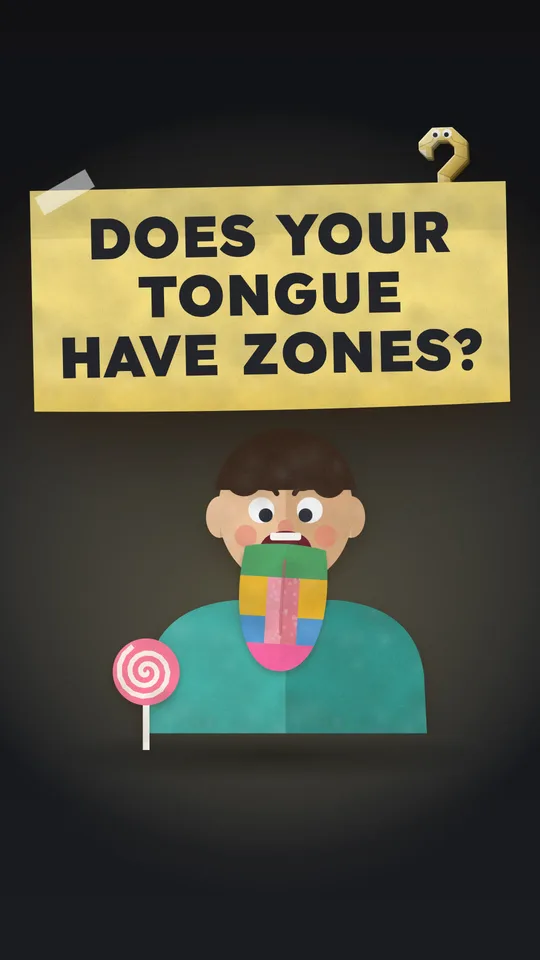
No. Taste buds in every part of the mouth that has them can pick up all five basic tastes2, 3. The famous map grew from a 1901 German study that found only small differences between spots on the tongue1. A well-known 1942 textbook redrew those results in a way that made the small differences look big, and later authors turned them into zones1, 7. Small differences between places are real, but they are nothing like the sharp zones of the old diagram1, 5.
Where the map came from
In 1901 a German researcher, David Pauli Hänig, measured the weakest taste people could still notice at different spots around the edge of the tongue1. His paper was titled 'Zur Psychophysik des Geschmackssinnes'7. He found people most sensitive to sweet near the tip, to sour on the sides and to bitter at the back1. His summary figure left out salt, which tasted about the same at all the spots he tested1. So the pattern was real. The differences were small.
In 1942 the Harvard psychologist Edwin Boring redrew Hänig's results in a well-known textbook1, 6. For each taste he took the reciprocals of Hänig's thresholds and divided them by the largest one1. Every curve was scaled to its own maximum. In the words of the taste researcher Linda Bartoshuk, 'there is no way to tell how meaningful the sizes of the variations are'1. Other authors read the low points of the curves as places with almost no taste at all1.
Boring drew curves, not zones. The zoned tongue turned up later, in articles such as a 1952 Scientific American piece and in many textbooks. The review we read says Boring's text 'may inadvertently' have led to it1. We found no good evidence for the popular claim that the German study was simply mistranslated1, 7.
What taste buds really do
Taste buds sit on the tongue, the soft palate and the throat2, 6. A 2009 review puts it plainly: 'taste buds from all regions of the oral cavity contain cells that respond to the five basic modalities'2. Each type of taste cell carries its own kind of receptor3. The same review concludes that 'there is no topographic map (i.e., a tongue map) of taste qualities on the tongue'2.
Taste buds are not spread evenly, though. The small mushroom-shaped bumps that carry many of them are densest at the tip and along the front edges1. A 19th-century study reported very few taste buds in the middle of the top of the tongue7. That is why some drawings show a taste 'belt' around the edge. It does not mean each part of the edge can taste only one thing1, 2.
A grain of truth, and a fifth taste
Later studies still find differences between places in the mouth, but much smaller ones, and they do not always agree1. In 1974 Virginia Collings measured thresholds again at several sites. Looking back, Bartoshuk wrote that Collings had shown the textbook 'fact' to be 'an exaggeration of the early work by Hanig'1. A 2022 review calls the differences 'significant (albeit small)'1.
Even for bitter, the results point in different directions. Collings found lower bitter thresholds at the front of the tongue and on the soft palate1. A 2019 study found bitter generally rated stronger on the back and middle of the tongue, while one bitter substance felt weakest at the front5.
The old map also had only four tastes. Hänig never tested umami, the savory taste6. Today it is counted as a fifth basic taste2, 3, and a receptor that senses amino acids, the substances behind umami, was described in 20024.
What we're not sure about
We could not read Hänig's 1901 paper, Boring's 1942 book or Collings's 1974 paper ourselves. What they found comes from a 2022 review1.
Who first drew the zoned tongue. The review we read says Boring's book 'may inadvertently' have led to it1. Popular articles disagree, and some say Boring drew the zones himself, which the reproduction of his graph in1 does not show.
How big the original differences were. One example in the review is a threshold three times lower at one spot than at another, which the researcher quoted there calls relatively small1.
Why bitter feels different in different places, and in which direction. The studies we read disagree1, 5.
Sources
- Spence C: The tongue map and the spatial modulation of taste perception, Current Research in Food Science 5:598-610, 2022 (peer-reviewed review, open access; full text read)
- Yarmolinsky DA, Zuker CS, Ryba NJP: Common sense about taste: from mammals to insects, Cell 139(2):234-244, 2009 (peer-reviewed review; full text read)
- Chandrashekar J, Hoon MA, Ryba NJP, Zuker CS: The receptors and cells for mammalian taste, Nature 444:288-294, 2006 (peer-reviewed review; abstract read)
- Nelson G, Chandrashekar J, Hoon MA, Feng L, Zhao G, Ryba NJP, Zuker CS: An amino-acid taste receptor, Nature 416:199-202, 2002 (peer-reviewed paper; abstract read)
- Higgins MJ, Hayes JE: Regional Variation of Bitter Taste and Aftertaste in Humans, Chemical Senses 44(9):721-732, 2019 (peer-reviewed paper; full text read)
- Munger SD, Wilson DM: That neat and tidy map of tastes on the tongue you learned in school is all wrong, The Conversation, 7 July 2015 (article by taste researchers)
- Wikipedia: Tongue map (encyclopedia article; used only for the title of Haenig's 1901 paper and the 1875 taste-bud observation)
- Caballar RD: Do Different Parts of the Tongue Taste Different Things?, BrainFacts.org (Society for Neuroscience), 3 January 2019
Researched and independently fact-checked on 17 November 2026. Found a mistake? Tell us at querigami@gmail.com and we will correct it here.
Even careful research can contain errors, and science keeps moving. This article is for general information and education only, not professional advice. We link to sources so you can check them yourself, but we are not responsible for the content of external websites.