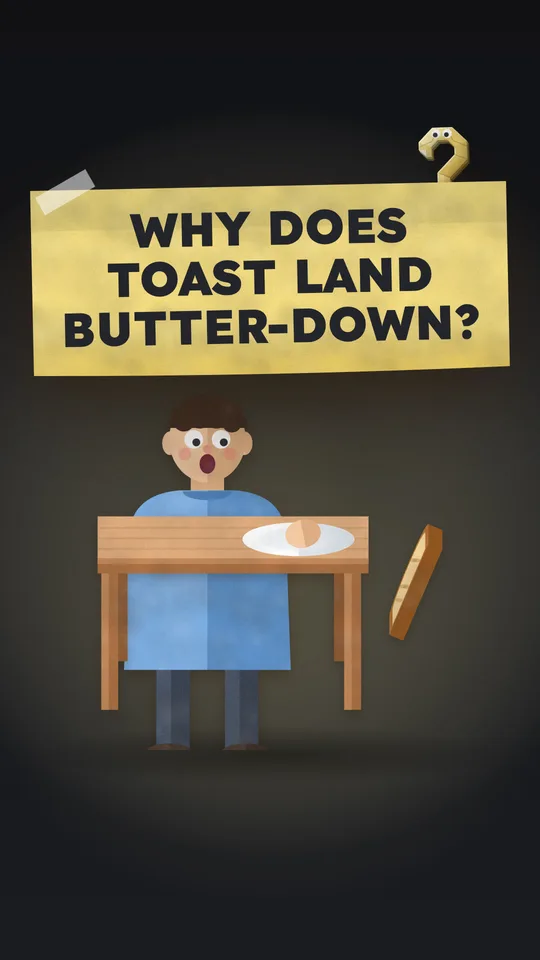
Mostly because of timing, not butter. Toast that slides off a plate or table starts to spin, but a normal table is too low for it to turn all the way over, so it usually lands after about half a turn1, 4, 7. In a big school experiment, about 62 percent of slices landed butter side down: a clear tilt, but far from 'always'6, 8.
Coin toss or real effect?
Many people believe dropped toast lands butter side down. Before Matthews' study, the usual scientific answer was that it is like a coin toss, with a 50/50 split1. In 1995, physicist Robert Matthews worked through the physics and found that toast does have a built-in tendency to land butter side down for a wide range of conditions1.
It's about spin and time
Toast usually starts butter side up. When it slides over the edge, it teeters and then starts to spin8. The spin is slow: by the time the toast hits the floor, it has not turned far enough to bring the butter back on top7, 8.
From a standard table about 75 cm high, a computer simulation shows the slice turning roughly half a turn, about 180 degrees4. Half a turn means butter facing the floor.
Does the butter matter?
Less than you might think. A layer of butter weighs about 4 grams, which is small compared with the slice, so it hardly changes how the toast turns1. One physicist showed that a thin, symmetric ruler would do the same thing4.
In a school test, toast marked with a 'B' instead of butter still landed B-side down 58 percent of the time, compared with 62 percent for buttered toast6. Butter may add a little, but it is not the main cause6, 7.
What 21,000 drops showed
In 2001, more than 1,000 schoolchildren in Britain let toast tumble off plates more than 21,000 times6. In the main test, 62 percent landed butter side down, well above the 50 percent you would expect from pure chance6, 8.
When the toast fell from more than about 2.4 meters (8 feet), only 47 percent landed face down6. The longer fall probably gave it time to keep turning.
How high would the table need to be?
To land butter side up, the toast needs about twice as much rotation, so it needs to fall about twice as long. Falling twice as long takes four times the height: roughly 4 × 0.75 m, or about 3 meters (about 10 feet)4. Matthews' own estimate was also around 3 meters2.
As a fun extra, Matthews linked this to our body size. He argued that the laws of physics limit how tall creatures like us can safely be, which in turn limits how high our tables are1.
Try it (safely)
Spread newspaper on the floor, butter one side of a slice, and push it off a table edge9. Matthews' tip: if toast is heading over the edge, give it a quick swipe to speed it up, and if it is sliding off a plate, move the plate quickly downward and backward2. Leaving fast means less time to build up spin9.
What we're not sure about
The exact share depends on how the toast leaves the edge. One study found that a toast-sized board from a 76 cm table lands butter side down only for some starting positions, not all3.
The spin is hard to predict: one study says you must include the slice slipping over the edge to get it right3, while another analysis assumes no friction at all4.
Whether butter adds a small effect is unclear: the 58 and 62 percent figures come from separate tests6.
Reports give different drop counts: about 21,000 drops in total, and it is not reported how these were split across the separate tests6.
An earlier BBC TV test found a 50/50 split, probably because the toast was tossed rather than slid off11; Matthews called those tests 'dynamically inappropriate'2.
Sources
- R. A. J. Matthews: Tumbling toast, Murphy's Law and the fundamental constants, European Journal of Physics 16(4):172-176, 1995 (original paper; read: publisher abstract + OCR text of sections 1-5 via Fermat's Library)
- R. A. J. Matthews: Tumbling Toast, Murphy's Law and the Fundamental Constants, author's own summary on semitrue.com, 1996 (author page; read: full text)
- M. E. Bacon, G. Heald, M. James: A closer look at tumbling toast, American Journal of Physics 69(1):38-43, 2001 (original study; read: abstract)
- S. Mahajan: Toast sliding off a table, American Journal of Physics 90(10):727-729, 2022 (original paper; read: full text, publisher HTML)
- R. A. J. Matthews: Testing Murphy's Law: Urban Myths as a Source of School Science Projects, School Science Review 83(302):23-28, 2001 (original report of the school experiment; read: abstract on ERIC)
- R. Matthews: Breakfast at Murphy's (or why the toast lands butter-side down), The Telegraph, 27 May 2001 (report; read: full text via a verbatim reprint, original page not reachable)
- R. Matthews: Why does toast often land butter-side down?, BBC Science Focus (report; read: full text)
- R. Matthews: Life itself lies in the 'law' of knots, The National, 12 July 2014 (report; read: full text)
- The Naked Scientists: Butter Side Down (home experiment, 2007; read: full text)
- The Oikofuge: R.A.J. Matthews: Tumbling Toast, Murphy's Law and the Fundamental Constants (blog review; read: full text)
- Wikipedia: Buttered toast phenomenon (overview, extra link only; read: full text)
Researched and independently fact-checked on 18 November 2026. Found a mistake? Tell us at querigami@gmail.com and we will correct it here.
Even careful research can contain errors, and science keeps moving. This article is for general information and education only, not professional advice. We link to sources so you can check them yourself, but we are not responsible for the content of external websites.