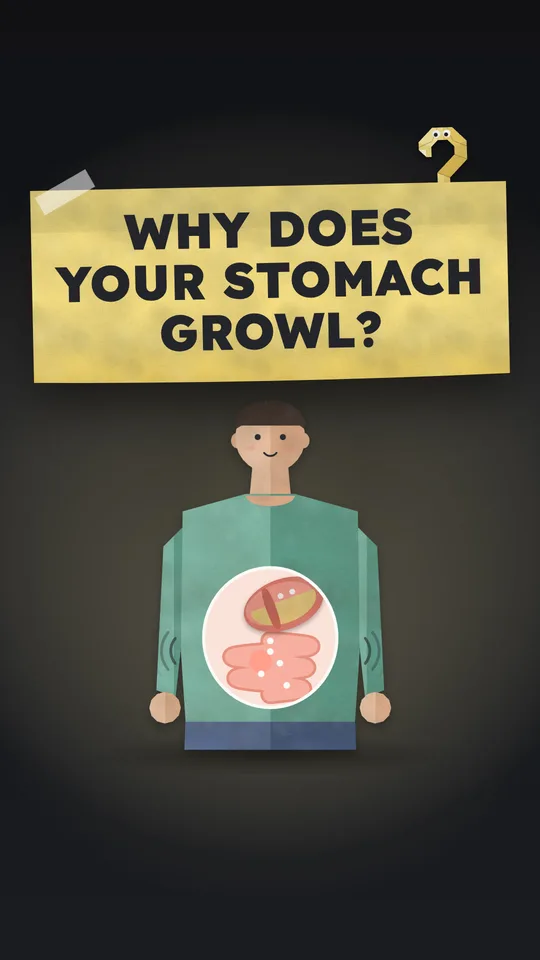
A growling stomach isn't really a hunger alarm. The rumble, called borborygmi, comes from muscle waves squeezing gas and fluid through the stomach and small intestine, empty or full1, 2. An empty gut just muffles it less, and between meals a strong clean-up wave sweeps through about every 90 to 120 minutes1, 3.
Not a hunger alarm
Growling can happen on an empty or a full stomach, and it comes from the small intestine just as often as from the stomach1. Right after a meal, there's plenty of squeezing going on2. The ancient Greeks named the sound borborygmi, a word meant to imitate the rumble itself1.
Your gut is a long muscular tube. Rings of muscle tighten one after another, pushing food, gas and fluid along, a motion called peristalsis1, 2. A built-in electrical rhythm sets the pace: about three times a minute in the stomach and 12 in the small intestine1, 2.
So why do we link it with hunger? Food in the gut muffles the noise1. An empty gut holds more air than solid material, so its rumbles can be much louder2.
The between-meal clean-up wave
Between meals, the gut cycles through the migrating motor complex: a quiet phase, irregular contractions, then a short burst of strong, regular ones called phase III3. In people, phase III returns every 90 to 120 minutes3. It starts in the stomach and travels down the small intestine, sweeping out leftover food, mucus and bacteria1, 4. Each burst can last 10 to 20 minutes, and eating switches the pattern off1, 4.
The hormone motilin seems to keep time, at least in the stomach: your body makes more of it while fasting, its levels peak with phase III every 90 to 120 minutes, and a dose of motilin can trigger an early wave3, 4, 10. Ghrelin, a hormone that helps trigger hunger, drives similar waves in rats and mice, but its role in humans is debated2, 3, 4.
Is the wave a hunger signal? In a 2016 study, fasting volunteers rated their hunger at 62.5 during a phase III in the stomach, versus 27.4 in the quiet phase, but only 40.4 during a phase III in the duodenum, the first part of the small intestine5. So hunger seems tied to the stomach part of the wave, while growling can happen without hunger1, 5.
Where the gas comes from
Everyone swallows a little air while eating and drinking, and more with fizzy drinks, gum or eating fast9. Bacteria in the large intestine add gas as they break down carbohydrates the stomach and small intestine couldn't fully digest9. Extra gas from foods like beans can make gut sounds louder2.
A century of eavesdropping
In 1905, physiologist Walter B. Cannon published the first scientific study of listening to the gut7. In 1912, he and A. L. Washburn tried something bolder: Washburn practiced for weeks swallowing a tube with a soft balloon about 8 centimeters wide6. Whenever he signaled hunger, strong stomach contractions were being recorded, and they had almost always nearly peaked before he pressed the key6. They also asked: "Indeed, who accepts dessert because he is hungry?"6
Today, researchers use contact microphones on the belly. One team tracked the clean-up cycle this way; the most common sound, a single burst, typically lasts only about 25 to 40 milliseconds7. Another recording caught more than 50 gut sounds in under 1.5 seconds8. Gut sounds are frequent but not rhythmic, and a full stomach is no guarantee of silence1, 8.
What we're not sure about
Exactly how each sound is made isn't settled; one review notes "a surprising lack" of experiments on it8.
What starts the clean-up wave is debated: a reflex sensing an empty stomach1, or hormones, with one review saying the mechanism "still remains unclear"3.
Sources clash on ghrelin: a review reports it can trigger an early wave in people4, but the 2016 study found motilin did and ghrelin didn't5.
Cycle length varies by source: 90 to 120 minutes3, 4, 80 to 1507, or one to two hours1.
Cannon and Washburn concluded the contractions cause hunger pangs6; the 2016 study links hunger only to the stomach part of the wave5.
The split between swallowed air and bacterial gas in a growl is unclear, since bacterial gas forms in the large intestine9.
Sources
- Andrews, M. A. W. (2002): Why does your stomach growl when you are hungry? Scientific American
- Duke, C. (2023): Why do our stomachs growl? Live Science
- Takahashi, T. (2013): Interdigestive migrating motor complex – its mechanism and clinical importance. Journal of Smooth Muscle Research (PMC)
- Ohno, T., Mochiki, E., Kuwano, H. (2010): The Roles of Motilin and Ghrelin in Gastrointestinal Motility. International Journal of Peptides (PMC)
- Tack, J. et al. (2016): Motilin-induced gastric contractions signal hunger in man. Gut (Europe PMC)
- Cannon, W. B., Washburn, A. L. (1912): An explanation of hunger. American Journal of Physiology (Reprint, Internet Archive/Wellcome Library)
- Du, X. et al. (2018): Bowel Sounds Identification and Migrating Motor Complex Detection with Low-Cost Piezoelectric Acoustic Sensing Device. Sensors (PMC)
- Nowak, J. K. et al. (2021): Automated Bowel Sound Analysis: An Overview. Sensors (PMC)
- NIDDK (o. J.): Symptoms & Causes of Gas in the Digestive Tract. National Institutes of Health
- Cleveland Clinic (2022): Motilin. Cleveland Clinic Health Library
Researched and independently fact-checked on 7 November 2026. Found a mistake? Tell us at querigami@gmail.com and we will correct it here.
Even careful research can contain errors, and science keeps moving. This article is for general information and education only, not professional advice. We link to sources so you can check them yourself, but we are not responsible for the content of external websites.