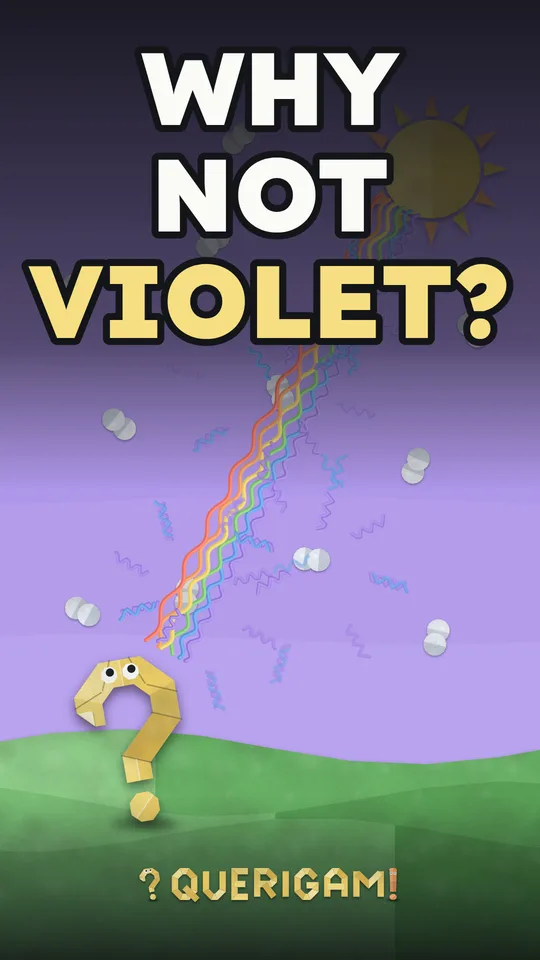
Air scatters violet light even more strongly than blue, so physics alone might predict a violet sky1, 8. But sunlight carries less violet than blue, and our eyes respond weakly to violet5, 6, 10. Our three cone types read the sky's violet-blue mix as pale blue: white light plus pure blue1, 2.
Violet wins the scattering race
Sunlight contains every colour6. Tiny nitrogen and oxygen molecules in the air scatter short waves much more than long ones6, 9. Air molecules send this scattered light off in all directions, so it reaches us from all over the sky16. This is Rayleigh scattering, and its strength scales as one over the wavelength to the fourth power8. Lord Rayleigh, then called John William Strutt, derived this law in 18713. Only in 1899 did he show that air molecules alone are enough to colour the sky3.
Do the maths and violet at 400 nm scatters about 1.6 times more than blue at 450 nm, and roughly 9 to 10 times more than red at 700 nm8. So why isn't the sky violet? Physicists point to several factors working together9.
Less violet arrives, and ozone isn't the culprit
The Sun does not shine equally in all colours8, 9. Measurements from a NASA research aircraft flying at about 12 km, corrected to the top of the atmosphere, give about 1.5 watts per square metre per nanometre at 400 nm, but about 2.1 at 450 nm5. That is roughly a third more blue than violet5. Scattering more than makes up for it. A rough estimate of our own, multiplying these sunlight values by the scattering law, gives about 20% more scattered light at 400 nm than at 450 nm, before losses on the way through the air, which shrink that lead5, 8. A 2026 preprint, using the same kind of model, likewise states that skylight contains more violet than blue13.
A popular claim says ozone eats the violet. The evidence points elsewhere. The ozone layer absorbs nearly all of the most harmful ultraviolet light, but it is mostly transparent to visible light12. Its visible absorption band, the Chappuis band, is centred around 600 nm, in the orange3. In 1953 E. O. Hulburt found that ozone has little effect on the daytime sky's colour4. But at sunset and twilight it helps keep the overhead sky blue4. A 2023 computer study confirmed that, with the Sun on the horizon, ozone causes about two-thirds of the overhead blue, and around half when the air is hazier3.
Your eyes do the final mix
For engineer Glenn Smith, this is the half of the story that usually gets left out1, 2. Our eyes have three kinds of colour-sensing cones, with peaks near 442, 543 and 570 nm2. By the standard 1924 brightness curve, the eye responds about 100 times more weakly at 400 nm than at 450 nm; newer, corrected curves put the gap closer to 15 to 20 times10, 15. The eye's lens also blocks most ultraviolet, and it absorbs more short-wave light as it yellows with age11.
In 2005 Smith showed that skylight is a 'metameric' match to unsaturated blue1. Put simply, your eye can't tell the sky's complicated spectrum from a mix of pure blue and white2. Calculations place that matching blue around 470 to 480 nm13. So the sky looks neither violet nor deep blue, but pale blue1, 8.
Near the horizon, light crosses more air, so the blue looks paler6, 7. At sunset, the long path scatters blue away, leaving reds and oranges6, 7. On Mars, fine dust flips the script: sunsets there glow blue around the Sun, while the rest of the sky looks yellow to orange14.
What we're not sure about
How much each factor matters is not settled. Weather services list our eyes and the Sun's weaker violet side by side6, 7. Smith argued that the usual explanation, based only on scattering, says little or nothing about the eye1, 2. We found no agreed ranking of the factors.
An older physics FAQ says the high atmosphere absorbs some violet8. But NOAA describes the ozone layer as mostly transparent to visible light, and ozone's visible band sits near 600 nm3, 12. We found no strong source showing that ozone removes violet.
Honeybees and some birds see ultraviolet, so the sky likely looks different to them2. A 2026 preprint, not yet peer reviewed, calculates that a honeybee's match for skylight would sit near 395 nm, much further toward violet than ours13. That is a model; nobody can ask a bee.
Sources
- Smith, G. S. (2005): Human color vision and the unsaturated blue color of the daytime sky. American Journal of Physics 73(7):590-597
- Schirber, M. (2005): Why skies are blue instead of purple. Space.com / NBC News, 19 July 2005 (interview with Glenn Smith)
- Lange, A., Rozanov, A., von Savigny, C. (2023): Revisiting the question 'Why is the sky blue?'. Atmospheric Chemistry and Physics 23:14829-14839
- Hulburt, E. O. (1953): Explanation of the brightness and color of the sky, particularly the twilight sky. Journal of the Optical Society of America 43(2):113-118
- Arvesen, J. C., Griffin, R. N., Pearson, B. D. (1969): Determination of extraterrestrial solar spectral irradiance from a research aircraft. Applied Optics 8(11):2215-2232
- Met Office (n.d.): Why the sky is blue and sunsets red. UK Met Office
- National Weather Service Flagstaff (n.d.): Why is the sky blue? NOAA National Weather Service
- Gibbs, P. (1997): Why is the sky blue? The Physics FAQ (hosted at UC Riverside, J. Baez)
- Baird, C. S. (2013): Why is the sky blue? Science Questions with Surprising Answers, West Texas A&M University
- Nave, C. R. (n.d.): Luminous Efficacy Tables (photopic V-lambda, CIE 1924). HyperPhysics, Georgia State University
- Hammond, B. R., Sreenivasan, V., Suryakumar, R. (2019): The effects of blue light-filtering intraocular lenses on the protection and function of the visual system. Clinical Ophthalmology 13:2427-2438
- Ciasto, L. (2020): Ultraviolet (UV) radiation: Don't feel the burn, avoid it! NOAA Climate.gov
- Weiss, Y., Springer, O. (2026): What Color is the Sky? (for a non-human)? arXiv:2606.28912 (preprint, not peer reviewed)
- NASA/JPL (2015): NASA's Curiosity rover views serene sundown on Mars. Jet Propulsion Laboratory news, 8 May 2015
- Sacek, V. (n.d.): Eye spectral response (photopic sensitivity curves CIE 1924 vs. Judd-Vos 1978). telescope-optics.net
- NASA Science Space Place (n.d.): Why is the sky blue? NASA
Researched and independently fact-checked on 23 October 2026. Found a mistake? Tell us at querigami@gmail.com and we will correct it here.
Even careful research can contain errors, and science keeps moving. This article is for general information and education only, not professional advice. We link to sources so you can check them yourself, but we are not responsible for the content of external websites.