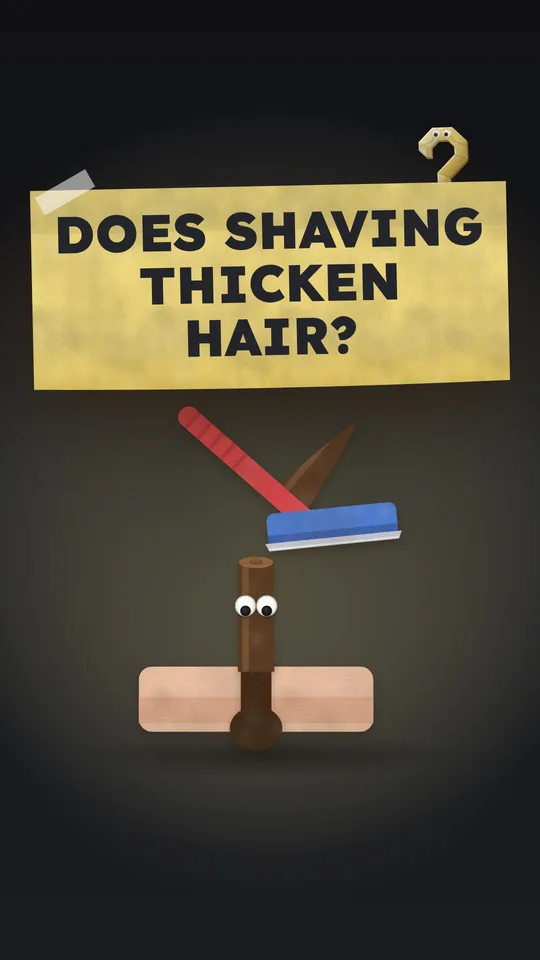
No. Shaving doesn't change how thick hair is, what colour it is or how fast it grows1. A razor cuts off the fine, tapered end of a hair and leaves a blunt stub, and that stub feels coarser and can look darker for a while1, 2.
The short answer
It's one of the most repeated bits of bathroom wisdom: shave once and the hair comes back thicker, darker and faster. Mayo Clinic's answer is blunt: "No". Shaving doesn't change hair's thickness, color or rate of growth1.
Cleveland Clinic calls the idea a myth and says shaving won't make hair regrow any thicker or faster4. Healthline says the same: shaving can't affect a hair's color, thickness or rate of growth5.
What the experiments found
People have tested this for about a century. A review of common medical myths in the BMJ notes that a clinical trial back in 1928 showed shaving had no effect on hair growth, and that more recent studies confirm it doesn't change the thickness or speed of regrowth2.
The most often cited test came in 1970. Five healthy young men each shaved one leg every week for several months and left the other leg alone for comparison. The researchers measured how much hair (by weight) grew in a marked patch of skin, plus how wide each hair was and how fast it grew. They found no significant differences in any of these that could be put down to shaving3. A historical overview counts this study among a handful from the 1960s and 70s that pretty much ended the scientific debate6.
The trick of the blunt end
Here's the real reason. A razor only removes the dead part of a hair, the bit above the skin. The living part below the surface is untouched2. A hair that has never been cut narrows to a fine, tapered tip. A shaved hair has lost that taper, and that's what makes it seem coarse2.
So instead of the thin, often lighter ends of long hairs, you're looking at the thicker bases of the hair shafts4. The blunt tip can feel coarse or "stubbly" as it grows out1, and freshly cut edges can feel sharp and prickly4. Short stubs also stand up straighter, because the follicle grips them firmly, and that adds to the bristly feel3.
Why stubble looks darker
Hair that has been around for a while gets lightened by sunlight and other chemical exposures. A newly grown stub hasn't had time to fade, so it looks darker than the hair you had before2. Soaps can lighten hair too5. Against lighter skin, the contrast makes new stubble even easier to spot5.
Stubble is also easier to notice simply because it's short. Nobody can see a full beard get longer from one day to the next, but on a clean-shaven face the new growth shows up the same day3.
What we're not sure about
The famous 1928 study is hard to pin down. Later accounts describe it differently, and we couldn't read the original paper, so we're not saying here who was shaved or which body part.
Not every early study agreed. Researchers in 1926, 1937 and 1961 reported faster hair growth after shaving, and several animal studies did too. Those animal results may have been skewed by small nicks in thin skin rather than by the shaving itself6.
The 1970 leg study involved only five young men3, so it's small, and it tells us more about leg hair than about every hair on every body.
Stubble does soften again as it gets longer4, but none of the sources we read explains exactly why. Our best guess is that a longer hair simply bends more easily. No source we read says a cut hair ever grows a new tapered tip.
Sources
- Mayo Clinic Staff: Hair removal: Does shaving affect hair growth? Mayo Clinic
- Vreeman RC, Carroll AE (2007): Medical myths. BMJ 335:1288-1289
- Karthikeyan K (2009): Tonsuring: Myths and facts. International Journal of Trichology 1(1):33-34
- Cleveland Clinic (with Taylor Bullock, MD): Will Shaving Make Your Hair Grow Back Thicker? Cleveland Clinic Health Essentials
- Cherney K (2019, med. reviewed by C. Cobb): Does Shaving Make Hair Grow Back Thicker? Healthline
- keratin.com (2024): The Enduring Myth of Hair Growth Stimulated by Shaving: A Historical Perspective. keratin.com
Researched and independently fact-checked on 14 November 2026. Found a mistake? Tell us at querigami@gmail.com and we will correct it here.
Even careful research can contain errors, and science keeps moving. This article is for general information and education only, not professional advice. We link to sources so you can check them yourself, but we are not responsible for the content of external websites.