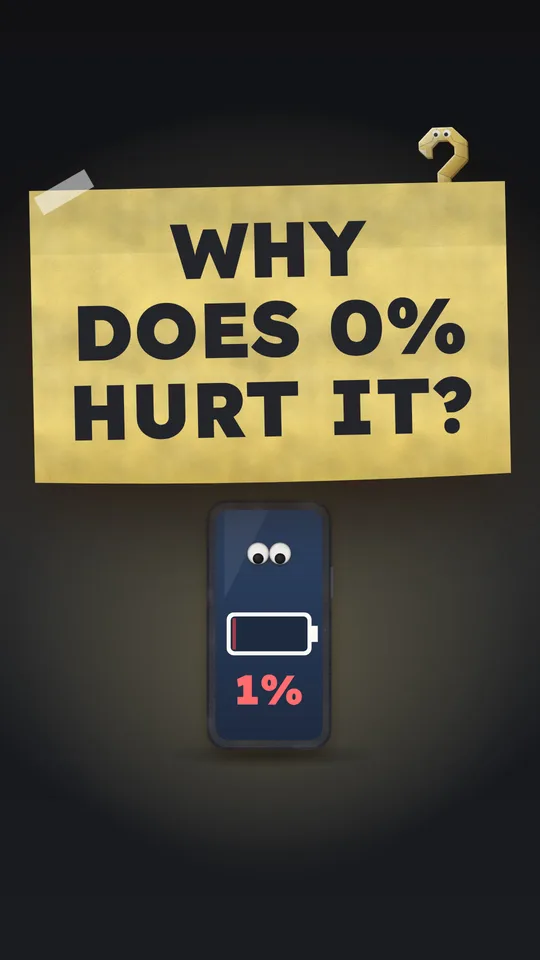
The advice to run a battery flat before recharging dates from nickel-cadmium batteries, where 'memory' was a recognized problem1, 2. Phones run on lithium-ion, which Battery University and Apple both describe as needing no full discharges3, 4. Lab data point the other way: in a multi-year study of commercial cells, deeper discharges wore them out faster5.
A rule from the nickel era
In the nickel-cadmium era of the 1970s and 1980s, battery trouble was blamed on 'memory': a cell seemed to remember how much energy had been drawn before and to deliver only that much1. Wikipedia, citing a General Electric engineering note, traces the term to an aerospace application in which cells were discharged by computer to the same 25 percent mark again and again, and then lost capacity beyond that point2. That exact effect proved hard to reproduce; one test program found none after more than 700 controlled cycles2.
Battery University describes a related nickel-cadmium problem: crystals on the negative plate grow from about 1 micron to 50-100 microns if a cell is left on the charger for days or repeatedly recharged without a periodic full discharge, and periodic full discharges were the remedy1. Nickel-metal-hydride batteries were affected less1.
Lithium-ion plays by different rules
Lithium-ion batteries work by moving ions between two electrodes3. Battery University states that partial discharge is fine, that there is no memory and that no periodic full discharges are needed, apart from occasionally calibrating a device's charge gauge3. Apple says there is no need to let its batteries discharge fully and counts use cumulatively: 75 percent one day plus 25 percent the next makes one charge cycle4.
Deep discharges actually cost lifespan. Battery University estimates that a cobalt-based NMC cell lasts about 300 cycles at 100 percent depth of discharge but about 2,000 at 20 percent before dropping to 70 percent capacity3; even counted by total energy delivered, shallow cycling comes out ahead. A multi-year study at Sandia National Laboratories, measured in equivalent full cycles, found that for all cells tested 'the rate of capacity fade increased with an increasing depth of discharge', most strongly in NMC and NCA cells5.
Why big swings wear a battery
The Sandia authors explain this with earlier research: graphite changes volume as lithium moves in and out, larger changes mean more stress and microcracks, and fresh cracks let the electrolyte react with lithium and use it up5. A 2025 study in Science imaged electrodes during charging and discharging and found particles moving unevenly, building local stress that can lead to cracks; its lead researcher described every 'breath' of the battery as slightly irreversible6.
Heat and full charge add stress of their own. Battery University estimates that a cell stored for a year at 25 °C keeps about 96 percent of its capacity at 40 percent charge but about 80 percent at full charge3. Apple warns that ambient temperatures above 35 °C can permanently damage battery capacity7, and iPhones can delay charging past 80 percent to shorten the time spent fully charged8.
What 0 percent really means
A phone showing 0 percent is usually not truly empty. Battery University reports that most phones switch off when the cell reaches 3.00 volts, with about 5 percent of capacity left, kept for housekeeping, to reduce stress and to allow for self-discharge9. Left uncharged for months, a cell can sink to about 2.5 volts, where its protection circuit opens and many packs can no longer be revived with a regular charger9.
What we're not sure about
Whether only the width of the charge window matters, or also where it sits (for example 20-80 versus 40-60 percent), is unsettled: the Sandia team notes that earlier studies disagree and that its own test design could not decide it5.
The cycle figures are estimates for cobalt-based cells; Battery University itself notes that not all batteries behave the same, and phones manage their cells in different ways3.
Lithium-ion is not memory-free in every form: researchers at the Paul Scherrer Institute and Toyota found a memory effect in lithium-iron-phosphate electrodes, a small voltage shift that can hide part of the stored energy and confuse charge readings10. Whether a comparable effect matters in phone batteries was not part of that work.
How much of a real phone's aging comes from cycling rather than heat and time spent full depends on use; Apple describes a battery's chemical age as a complex combination of factors including temperature history and charging pattern8.
Sources
- Battery University / Cadex (undated): BU-807: How to Restore Nickel-based Batteries. Battery University
- Wikipedia contributors (2026): Memory effect. Wikipedia (section 'True memory effect', citing a General Electric battery application note)
- Battery University / Cadex (undated): BU-808: How to Prolong Lithium-based Batteries. Battery University
- Apple (undated): Why Lithium-ion? Apple Batteries
- Preger, Y., Barkholtz, H. M., Fresquez, A. et al., Sandia National Laboratories (2020): Degradation of Commercial Lithium-Ion Cells as a Function of Chemistry and Cycling Conditions. Journal of The Electrochemical Society 167, 120532 (open access)
- Puiu, T. (2025): Your Phone Battery Is Constantly 'Breathing' and That Motion May Be What Eventually Kills It. ZME Science (reporting on a 2025 Science paper from UT Austin, Northeastern, Stanford and Argonne)
- Apple (undated): Maximizing Battery Life and Lifespan. Apple Batteries
- Apple Support (undated): About Charge Limit and Optimized Battery Charging on iPhone. Apple
- Battery University / Cadex (2019): BU-802c: How Low can a Battery be Discharged? Battery University
- Leiva, L., Paul Scherrer Institute (2013): Memory effect now also found in lithium-ion batteries. Phys.org (on Sasaki et al., Nature Materials 2013)
Researched and independently fact-checked on 13 November 2026. Found a mistake? Tell us at querigami@gmail.com and we will correct it here.
Even careful research can contain errors, and science keeps moving. This article is for general information and education only, not professional advice. We link to sources so you can check them yourself, but we are not responsible for the content of external websites.