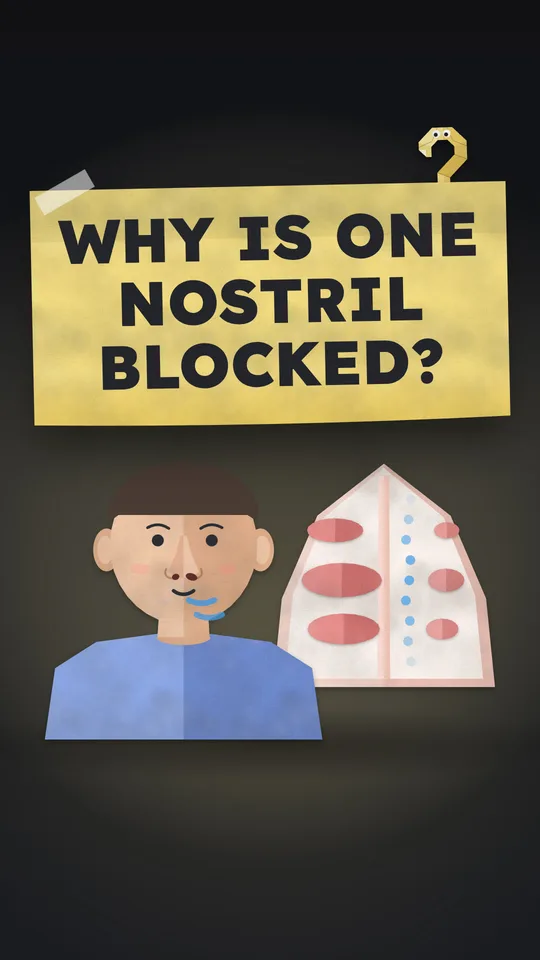
One side of your nose usually does carry more air: spongy tissue inside each nostril swells and shrinks in turns, a normal rhythm called the nasal cycle1, 2. Most people don't notice it, because the nose as a whole stays about as easy to breathe through3; a cold or lying on your side can exaggerate it1, 4, 5.
A swelling switch inside your nose
Inside your nose, along the side walls and the central divider, sits spongy tissue full of veins1, 2. When it fills with blood it swells and narrows that air passage; when it drains, the passage opens1. The autonomic nervous system, which runs your body on autopilot, flips the switch: stronger sympathetic signals shrink the tissue on one side while the other side swells1, 2. Every so often, the sides swap.
The German physician Richard Kayser described this alternation in 18952. How long one side stays in charge varies a lot: a review gives 30 minutes to 6 hours2. In a 2016 study, 33 healthy volunteers wore a small airflow logger for about a day; one nostril stayed dominant for anywhere from 15 minutes to over 10 hours, on average about 2 hours awake and 4.5 hours asleep1.
Blocked on one side? That alone doesn't mean you're sick
A one-sided nose is normal. In a 1977 study of 50 people, 72% showed a clear cycle, and the authors noted that people are not usually aware of it because the total resistance of the nose stays fairly constant3. A 2018 review puts it at almost 70 to 80% of healthy adults2.
A cold doesn't create the lopsidedness; it turns up the volume. Twelve people were measured over six hours during a cold and again weeks later when healthy. Both times, all of them showed side-to-side swings, but during the cold the swings were larger, "with one nasal passage often becoming severely congested"4. At their most open, the nasal passages were about as open as in health; at their most blocked, they were far more blocked4.
Why the bottom nostril closes when you lie on your side
Lying down adds to this. Going from sitting to lying raises the pressure in your veins, which can swell the nasal lining2, and lying down makes the cycle's swings bigger5. On your side, the lower nostril tends to close and the upper one to open2; in the 2016 study, lying on one side was linked to more airflow through the opposite nostril1.
Is that just gravity? Experiments point to a reflex as well. Pressing a crutch into one armpit for 15 minutes raised resistance on that side of the nose and lowered it on the other6. In 60 adults, pressure or warmth at the armpit raised resistance on the same side; the drop on the other side was not statistically significant7. Researchers call this the corporo-nasal reflex, and a review notes that turning the whole body matters more than turning just the head2.
What might it be good for?
Nobody knows for sure. One hypothesis: the swollen side rests from drying airflow and helps top up the moisture of the mucus2. A 2015 computer model of the nasal airways backs this up: with each breath in, the side carrying most of the air partly dries out, while the swollen side stays moist enough to keep moving mucus along, and when the sides swap, the tired side gets its turn to rest and recover12. Another is that the rhythmic swelling works like a pump, pushing out plasma fluid that may help defend against germs9.
The most surprising idea is about smell. Some odor molecules soak into the nasal lining quickly, others slowly, so how strongly they register may depend on how fast the air flows8. In a 1999 experiment, 20 people sniffed the same 50/50 mix of two odorants, L-carvone and octane, one nostril at a time; 17 judged it to contain more octane, the slow-soaking one, through their low-airflow nostril8, 11. When eight were retested after their nostrils had switched, the perception flipped in seven8, 11. The difference is very subtle, though, and probably goes unnoticed most of the time11. Each nostril, the authors suggest, sends the brain a slightly different picture of the smell world8.
Try it yourself, home version: breathe out through your nose onto a cold mirror and compare the two misty patches, a simple way researchers have used to check nasal airflow1. Or gently press one nostril closed, breathe in, and swap. Check again an hour or two later; your result may have flipped1.
What we're not sure about
How common the cycle is depends on the definition: 72% in one 1977 study3 and 70 to 80% in a 2018 review, but only 21 to 39% show truly regular, back-and-forth switching2. Meanwhile, every participant in a 24-hour study switched sides at least once1, and a second 24-hour study found that most people mix several patterns over a day10.
The textbook picture says the nose's total resistance stays roughly constant3, 5, yet long recordings show that both sides sometimes swell and shrink together, especially while awake, instead of taking turns1, 10.
What the cycle is for is still open: air conditioning, germ defence and smell are hypotheses (the drying-and-resting idea is backed by a computer model12, not by direct measurements), and studies disagree on which side clears mucus faster2, 9.
What sets the clock: the autonomic nervous system is clearly involved, but cycles have been seen even after some nerve cuts, and a central controller in the brain is suspected rather than proven1, 2.
How much of the side-lying effect is gravity versus reflex, and whether the switch holds or drifts back if you stay in one position, is not settled1, 2.
The smell finding rests on one small experiment with 20 people8, 11.
Sources
- Kahana-Zweig R, Geva-Sagiv M, Weissbrod A, Secundo L, Soroker N, Sobel N (2016): Measuring and Characterizing the Human Nasal Cycle. PLOS ONE 11(10), e0162918
- Pendolino AL, Lund VJ, Nardello E, Ottaviano G (2018): The nasal cycle: a comprehensive review. Rhinology Online 1, 67-76
- Hasegawa M, Kern EB (1977): The human nasal cycle. Mayo Clinic Proceedings 52(1), 28-34
- Eccles R, Reilly M, Eccles KS (1996): Changes in the amplitude of the nasal cycle associated with symptoms of acute upper respiratory tract infection. Acta Oto-Laryngologica 116(1), 77-81
- Cole P, Haight JS (1986): Posture and the nasal cycle. Annals of Otology, Rhinology & Laryngology 95(3 Pt 1), 233-237
- Davies AM, Eccles R (1985): Reciprocal changes in nasal resistance to airflow caused by pressure applied to the axilla. Acta Oto-Laryngologica 99(1-2), 154-159
- Preece M, Eccles R (1993): The effect of pressure and warmth applied to the axilla on unilateral nasal airway resistance and facial skin temperature. Acta Oto-Laryngologica 113(6), 777-781
- Sobel N, Khan RM, Saltman A, Sullivan EV, Gabrieli JDE (1999): The world smells different to each nostril. Nature 402(6757), 35
- Eccles R (1996): A role for the nasal cycle in respiratory defence. European Respiratory Journal 9(2), 371-376
- Reins EF, Weindel C, Hoffmann TK, Sommer F, Stupp F, Halbig AS, Lindemann J (2022): Definition und Darstellung der verschiedenen Typen des Nasenzyklus mittels Langzeitrhinometrie [Definition and illustration of the different types of nasal cycle using long-term rhinometry]. HNO 70(2), 94-101
- O'Toole, K. (2000, Spring): Your nostrils may part ways. Stanford Medicine magazine
- White DE, Bartley J, Nates RJ (2015): Model demonstrates functional purpose of the nasal cycle. BioMedical Engineering OnLine 14, 38
Researched and independently fact-checked on 8 November 2026. Found a mistake? Tell us at querigami@gmail.com and we will correct it here.
Even careful research can contain errors, and science keeps moving. This article is for general information and education only, not professional advice. We link to sources so you can check them yourself, but we are not responsible for the content of external websites.