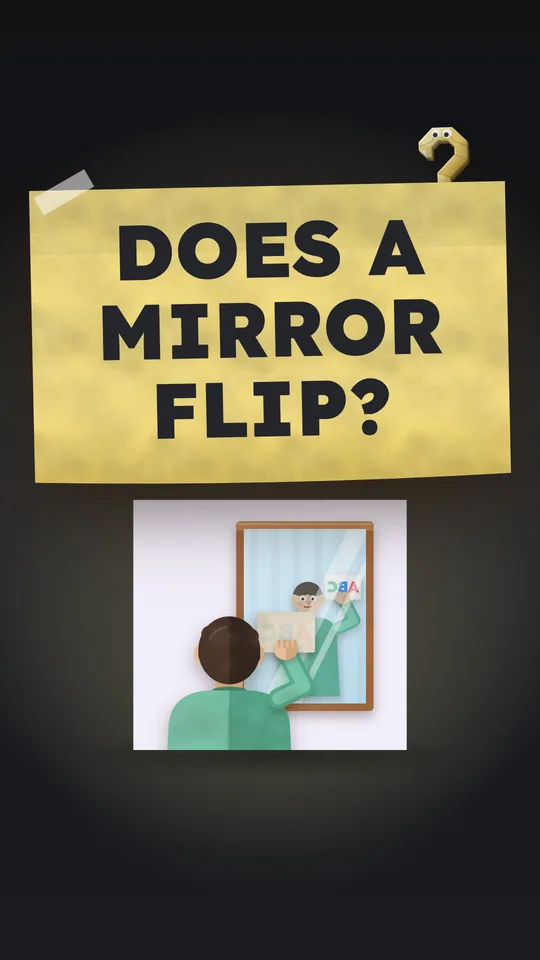
Not really. A flat mirror reverses front and back, not left and right1, 2. Most physics explanations say the swap we seem to see comes from turning things, or ourselves, to face the mirror, and from reading the reflection as a person who has turned around1, 3, 4. How exactly the mind does this is still debated9.
What a mirror actually does
Stand in front of a mirror and move your hand to the right. The hand in the mirror moves to the same side. Now move your hand toward the mirror. The reflected hand moves the opposite way, toward you1.
That is the only direction a flat mirror reverses: the one that runs straight into the glass1, 6, 11, 12. Purdue University's physics lecture-demonstration notes say it is 'commonly misstated, even in some texts' that a mirror swaps right and left1. A physics text by David Harrison reaches the same answer: front and back are what get reversed2.
Try it yourself
Raise your right hand. The raised hand in the mirror is on the same side as yours2. A shirt pocket or a mole on your face does not jump to the other side either1. Only if the mirror person were real would we say they are raising their left hand2.
Now write a word on paper and hold it up to the mirror. It looks backwards. But to show it to the mirror, you had to turn the paper around3, 4. Write the word on a clear plastic sheet instead and hold it up without turning it. The mirror shows it the right way round3. A Purdue demo uses the word CAR on a see-through sheet. Once the white backing is removed, the sheet itself, seen from behind, looks just as reversed as the reflection: the mirror added no reversal1.
The psychologist Richard Gregory suggested a test with a book. Turn it around its vertical axis to face the mirror, and the letters look left-right reversed. Turn it around its horizontal axis instead, and the reversal becomes up-down4.
So why does it feel like a swap?
Our bodies are roughly the same on the left and on the right. Because of that, the Purdue demo explains, we think another person is facing us, and that this person has turned around1.
Gregory put the weight on real turning. Objects must be rotated to face the mirror, and books are usually turned around their vertical axis because of gravity4. To see yourself in a wall mirror, you turn around too, around a vertical axis, because your feet are on the ground4. Even in a car mirror, where the number plates behind you look reversed, Gregory points out that your head is turned 180 degrees away from those cars4.
What we're not sure about
There is still no agreed explanation, the psychologists Yohtaro Takano and Akihiro Tanaka wrote in 20079. Some researchers say physics settles it. In 1993, Haig explained the effect with optics and left only perception to psychology5. In the same year, Morris, reviewing the optical explanations of Gregory and Haig, concluded that the reversal is 'not specifically optical' but depends on several factors8. In 2000, Tabata and Okuda argued it 'essentially does not involve psychological processes'7.
Michael Corballis argued that mirrors perform only one kind of reversal: they simply reverse about their own planes6. When we compare a thing with its reflection, he argued, we turn it in our mind into its normal upright, forward-facing position, so the difference shows up as left-right6. Takano and Tanaka report that their experiments contradict both this account and the one based on physically turning the object. They see mirror reversal as three different effects with three different causes9. Takano's own count changed: in 1998 he proposed four kinds of reversal6; by 2007, with Tanaka, it was three9.
Do we even see ourselves reversed? In Takano and Tanaka's experiments, a substantial share of students denied that a person's mirror image is left-right reversed, yet almost all saw the reversal in a written character9. Gregory also suspected that we do not see ourselves reversed, since we never see our own face directly to compare4. A 2008 study found that people tended to judge their reflection as identical when the mirror was in front of them, and that feeling oneself left-right reversed was not a common experience10. To us, this sits uneasily with the simple 'turned-around person' explanation.
Sources
- Purdue University, Department of Physics and Astronomy, Lecture Demonstrations, Demo 7A-03: Left-to-Right Reversal, ohne Jahr (gelesen: ganze Seite)
- David M. Harrison, Mirror Symmetry, Physics LibreTexts (Supplemental Modules, Modern Physics), ohne Jahr (gelesen: ganze Seite)
- Chris Woodford, How do mirrors work?, Explain that Stuff, aktualisiert 2023 (gelesen: Abschnitt zur Seitenverkehrung)
- Richard Gregory, Seeing oneself (Editorial), Perception 30:903-904, 2001 (gelesen: ganzer Text, PDF)
- N. D. Haig, Reflections on inversion and reversion, Perception 22:863-868, 1993 (gelesen: Abstract ueber Europe PMC)
- Michael C. Corballis, Much ado about mirrors, Psychonomic Bulletin and Review 7:163-169, 2000 (gelesen: Abstract ueber Europe PMC)
- T. Tabata, S. Okuda, Mirror reversal simply explained without recourse to psychological processes, Psychonomic Bulletin and Review 7:170-173, 2000 (gelesen: Abstract ueber Europe PMC)
- R. C. Morris, Mirror image reversal: is what we see what we present?, Perception 22:869-876, 1993 (gelesen: Abstract ueber Europe PMC)
- Yohtaro Takano, Akihiro Tanaka, Mirror reversal: empirical tests of competing accounts, Quarterly Journal of Experimental Psychology 60:1555-1584, 2007 (gelesen: Abstract ueber Europe PMC)
- I. Bianchi, U. Savardi, The relationship perceived between the real body and the mirror image, Perception 37:666-687, 2008 (gelesen: Abstract ueber Europe PMC)
- Wikipedia, Mirror image, abgerufen 2026-11-18 (nur Zusatzverweis; gelesen: Abschnitte zu Spiegelachse, Karte, Psychologen, Rettungswagen)
- Physics FAQ: Do Mirrors Reverse Left and Right?, Usenet Physics FAQ (gehostet an der UC Riverside), ohne Jahr (gelesen: ganze Seite, Faktenpruefer)
Researched and independently fact-checked on 18 November 2026. Found a mistake? Tell us at querigami@gmail.com and we will correct it here.
Even careful research can contain errors, and science keeps moving. This article is for general information and education only, not professional advice. We link to sources so you can check them yourself, but we are not responsible for the content of external websites.