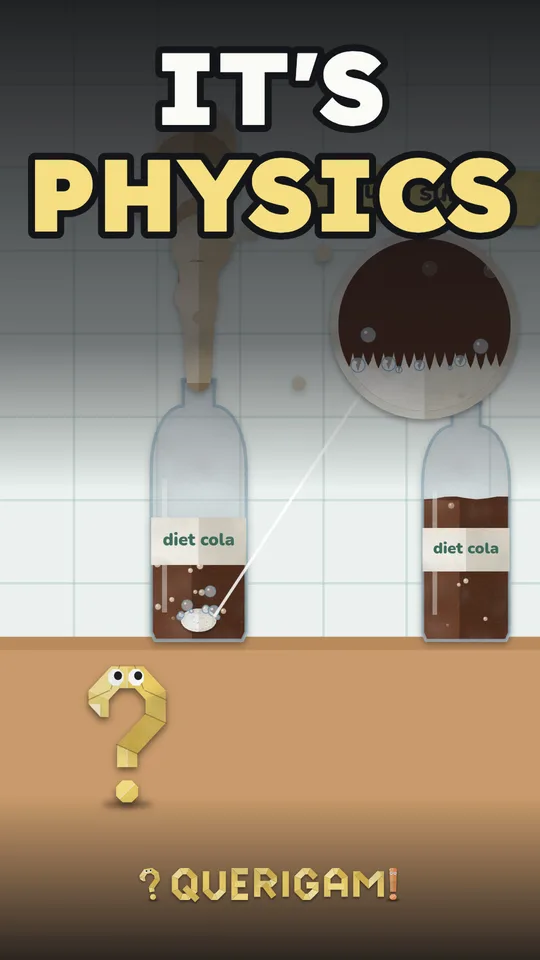
It isn't the chemical reaction it looks like: the study that tested it calls it a physical reaction. The soda's pH doesn't change, and the carbon dioxide was already dissolved in the drink1. A mint candy's surface is covered in microscopic pits where bubbles can start, so a large share of the gas that would normally leak out over minutes or hours escapes in seconds2, 5. Ingredients in the soda seem to help, but researchers still disagree about how1, 2, 3.
It's not the chemistry you think
It looks like a chemical reaction, so it's easy to assume the candy and the soda react the way baking soda and vinegar do. A 2008 study in the American Journal of Physics checked this. The Diet Coke had a pH of 3.0 before the Mentos went in and 3.0 afterward1. None of the candy's listed ingredients is basic, and the carbon dioxide is not made by a reaction. It was already dissolved in the soda, and the candy only upsets that balance1. Adding baking soda, a real acid-base reaction, raised the pH to 6.11.
Why your open bottle only fizzes slowly
Sodas are sealed under carbon dioxide at pressures of about 3 to 5 bar. At 4 bar, a liter holds roughly 6 grams of the gas at room temperature2. Once the bottle is open, nearly all of it will leave, but slowly, over minutes or hours2, 5.
The bottleneck is the bubble itself. A new bubble has to create a fresh boundary between gas and liquid, and that is a large energy barrier. So the gas mostly escapes through the small surface at the top, or from the few specks of dust and fiber that hold tiny trapped gas pockets2.
Hundreds of thousands of tiny launch pads
A mint candy changes the numbers. Its surface is covered in pits and pockets, and each one can act as a nucleation site, a place where bubbles are born2. One rough estimate allows 5 to 60 million possible sites on a single candy; a different calculation suggests 50,000 to 300,000 actually produce bubbles2. Either way, the gas suddenly has a huge number of exits. In one 2021 experiment, a candy took the dissolved gas in half a liter of soda from about 6 grams per liter down to about 2.5 within roughly ten seconds2.
Speed matters too, the study argues. A Mentos sank to the bottom of a 2-liter bottle of water in about 0.7 seconds, faster than rock salt or sand. Bubbles that start low have farther to rise and can collect more dissolved gas on the way, which the author links to stronger eruptions1.
What the soda brings
In the 2008 tests, drinks sweetened with aspartame erupted harder. With mint candies in 1-liter bottles, diet tonic water lost 540 grams, regular tonic 430 grams and plain seltzer just 94 grams1. Drops of water containing aspartame or potassium benzoate sat flatter on plastic than pure water did, at a lower contact angle1. From those angles, and assuming the surface tension was 5 percent lower than in pure water, the study estimated that forming a bubble takes about 67 and 60 percent of the work needed in pure water, which would make bubbles easier to start1. Caffeine barely mattered1.
What we're not sure about
How much surface tension matters is disputed. The 2008 study did not measure it directly but assumed a value1. Later experiments found that sugars, citric acid and flavor compounds also make taller fountains3, although some additives that boost fountains actually raise surface tension2. Those researchers think dissolved substances may stop bubbles from merging3. Why diet sodas spray higher than sugared ones is still called an open question2.
The candy's own ingredients are contested. The 2008 study credits the gum arabic in the coating, together with the rough surface1. A 2020 study found that the speed of foam production seemed unaffected by certain candy ingredients4, which a later paper lists as gum arabic and gelatin2.
How many pits really work is not settled. The gap between millions of possible sites and hundreds of thousands of active ones is not yet resolved; the authors suggest smooth patches, inactive pores and the dissolving candy as partial reasons2.
Sources
- Coffey, T. S. (2008): Diet Coke and Mentos: What is really behind this physical reaction? American Journal of Physics 76(6): 551-557 (doi 10.1119/1.2888546)
- Kuntzleman, T. S.; Kuntzleman, J. T. (2021): Ethanol as a Probe for the Mechanism of Bubble Nucleation in the Diet Coke and Mentos Experiment. Molecules 26(6): 1691 (doi 10.3390/molecules26061691)
- Kuntzleman, T. S.; Davenport, L. S.; Cothran, V. I.; Kuntzleman, J. T.; Campbell, D. J. (2017): New Demonstrations and New Insights on the Mechanism of the Candy-Cola Soda Geyser. Journal of Chemical Education 94(5): 569-576 (doi 10.1021/acs.jchemed.6b00862)
- Kuntzleman, T. S.; Annis, J.; Anderson, H.; Kenney, J. B.; Doctor, N. (2020): Kinetic Modeling of and Effect of Candy Additives on the Candy-Cola Soda Geyser: Experiments for Elementary School Science through Physical Chemistry. Journal of Chemical Education 97(1): 283-288 (doi 10.1021/acs.jchemed.9b00796)
- Appalachian State University (2008): Students Explore The Physics Of Fizz. Press release, published on ScienceDaily, 13 June 2008
Researched and independently fact-checked on 3 November 2026. Found a mistake? Tell us at querigami@gmail.com and we will correct it here.
Even careful research can contain errors, and science keeps moving. This article is for general information and education only, not professional advice. We link to sources so you can check them yourself, but we are not responsible for the content of external websites.