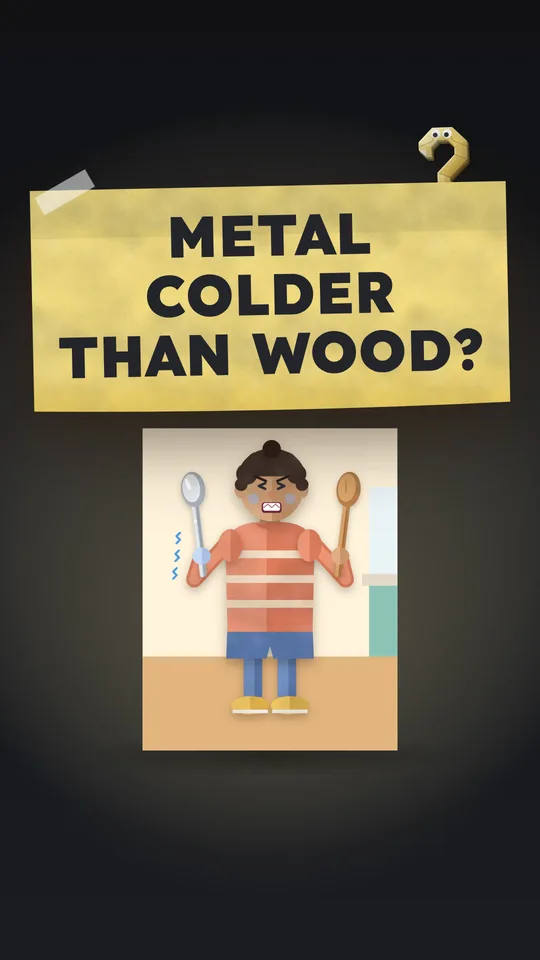
If metal and wood have been sitting in the same room, they are the same temperature, and a thermometer shows this1, 2. Metal only feels colder because it pulls heat out of your warm skin faster1, 2, 7. Here is a neat test: an ice cube melts much faster on an aluminium block than on a plastic one, even though the aluminium feels colder3, 4.
Same room, same temperature
Try this. Leave a piece of metal, a piece of wood and some foam in a room for about an hour, then press your palm on each one. The metal feels coldest. But an infrared thermometer shows that they are all at the same temperature1. One physics activity says that metal and wood in a room both read about 24 °C, which is room temperature2. In a university demonstration, an aluminium block and a plastic block both measured 17.5 °C, yet the metal one felt much colder4.
Your hand senses heat flow, not temperature
Your hand is usually warmer than the room, so heat flows out of your skin into whatever you touch12. Metal is a good conductor. It carries that heat away quickly, so the spot you touch cools down fast, and that is the feeling we call “cold”1, 2. Wood and foam are poor conductors. They carry very little heat away, so your skin stays warmer1, 2.
The difference is huge. In one research table, aluminium conducts heat at about 238 watts per metre per kelvin, while wood manages roughly 0.23 to 0.48. That makes aluminium several hundred to about a thousand times better at conducting heat. That does not mean your hand loses a thousand times more heat on metal: the skin itself and the contact limit the flow, but the difference is still easy to feel. Scientists who study touch use a slightly richer number called the contact coefficient. It combines how well a material conducts heat with how much heat it can soak up, and it decides whether the temperature where skin and object meet ends up closer to the skin’s temperature or the object’s7. Materials with a high contact coefficient, such as metals, give a lower contact temperature, which explains why metal feels cold7.
Special nerve endings in your skin called cold receptors notice this cooling7. They are sensitive: people feel mild coolness when their skin cools by as little as about 1 °C10.
The ice cube surprise
Now for the twist. Take two blocks that look the same, one aluminium and one plastic, and let them reach room temperature. When you touch them, one feels much colder. Now put an ice cube on each. The ice on the “colder” block melts much faster3. Other university physics demonstrations report the same result: the cube on the aluminium melts faster5, 6.
Why? The ice is colder than both blocks, so heat flows from each block into its ice cube. Aluminium delivers that heat much faster4, 5. It is the same reason it felt cold to you: metal moves heat quickly, out of your hand and into the ice2, 4.
A thermal camera shows the same thing from the other side. After two thumbs touch a metal ruler and a wooden ruler for a minute, the metal ruler actually looks warmer than the wooden one, because it took more heat from the thumb9.
On a hot day, it flips
If an object is warmer than your skin, heat flows the other way, into your hand, and you feel warmth instead of cold7. So on a hot summer day, when the air is warmer than your body, metal feels hotter than wood9. The same goes for things that are much hotter than your skin, like a bench in the sun: then the metal one feels hotter13.
A very common mix-up
Lots of people think metal simply is colder. One science education group calls the belief that metals are naturally colder than wood a misconception that students often hold9. Research on everyday heat ideas found that teenagers, adults and even scientists had trouble explaining everyday heat events11. The mix-up is easy to understand: for most of the year the air is cooler than our bodies, so metal usually does feel colder9.
What we're not sure about
Most everyday explanations mention only conduction. Touch researchers describe coldness with the contact coefficient, which also includes how much heat a material can store, and an object’s thickness matters too7.
The simple contact-temperature model works best for the first few seconds of a touch. For longer touches it tends to overestimate how much the skin cools, partly because of blood flow in living skin7.
How hard you press and how rough the surface is both make a difference. Pressure matters, though not in a simple way, and roughness does not behave the way the simple models predict7.
Wood is a tricky case for one detailed model of finger contact, because wood conducts heat about as well as skin does8.
Which molecules in the skin detect cold is still being studied. One sensor, called TRPM8, is a key cold detector, but scientists disagree about the role of others10. The review we read is from 2005, so newer work may have moved on.
The demonstrations we read say the ice melts “much faster” on aluminium but give no exact times3, 5, 6. The result will likely depend on block size, the type of plastic and the room.
Touching changes the experiment: after a few rounds of being touched, the materials warm up above room temperature1.
Sources
- Exploratorium: Cold Metal (Science Snack). Exploratorium, San Francisco, undated (page text)
- American Physical Society: Getting Warmer / Getting Colder (learning resource). APS, undated (page text)
- Yale University Physics Lab Demonstrations: 4B30.13 Melting Blocks. Yale University, undated (page text)
- UC Santa Cruz Physics Demo Room: Ice Melting Blocks (Physics 5B/6B demos). University of California, Santa Cruz, undated (page text)
- Saint Mary's University Physics Demos: “Seeing” Thermal Conductivity (201). Saint Mary's University, Halifax, undated (page text)
- Purdue University Physics Demos: 3B-05 Ice Melting Blocks. Purdue University, undated (page text)
- Ho, H.-N.: Material recognition based on thermal cues: Mechanisms and applications. Temperature 5(1):36–55, 2018 (online 2017) (full text)
- Rykaczewski, K.: Modeling thermal contact resistance at the finger-object interface. Temperature 6(1):85–95, 2019 (online 2018) (full text)
- Xie, C.: Why do Metals Feel Colder than Wood? Institute for Future Intelligence, updated 2026 (page text)
- McKemy, D. D.: How cold is it? TRPM8 and TRPA1 in the molecular logic of cold sensation. Molecular Pain 1:16, 2005 (full text)
- Lewis, E. L.; Linn, M. C.: Heat Energy and Temperature Concepts of Adolescents, Adults, and Experts: Implications for Curricular Improvements. Journal of Research in Science Teaching 31(6):657–677, 1994 (abstract only)
- Lienhard, J. H.: Engines of Our Ingenuity No. 1149: Hot and Cold. University of Houston, undated (page text)
- Nave, R.: HyperPhysics: Wood and Metal Temperature. Georgia State University, undated (page text)
Researched and independently fact-checked on 19 November 2026. Found a mistake? Tell us at querigami@gmail.com and we will correct it here.
Even careful research can contain errors, and science keeps moving. This article is for general information and education only, not professional advice. We link to sources so you can check them yourself, but we are not responsible for the content of external websites.