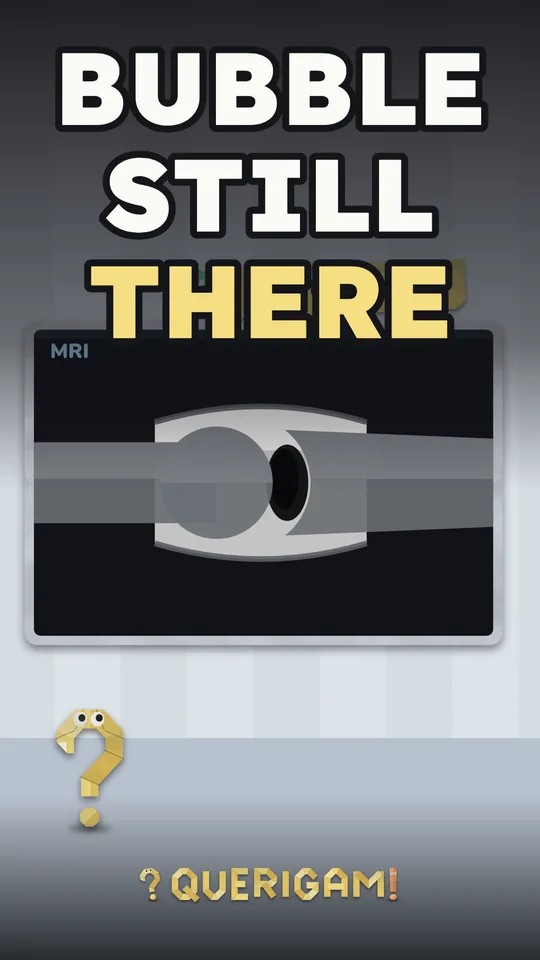
The crack comes from a gas bubble in the fluid inside your finger joint. A 2015 MRI study filmed that bubble appearing at the moment of the crack and staying there after the sound, rather than bursting1. A 2018 computer model argues instead that a bubble collapsing only partly could explain the sound2. Studies so far have not found a link between habitual knuckle cracking and arthritis4, 5.
The old story: a popping bubble
Look at your hand. The big knuckles where your fingers meet your palm are joints, and the space between the bones is filled with a liquid called synovial fluid1. When you pull or bend a finger, those bones are drawn apart. In 1947, researchers proposed that this creates a vapour bubble. In the 1970s another team argued that the noise comes from a bubble collapsing: the 'popping bubble' explanation8.
Filming a crack from the inside
In 2015, a team at the University of Alberta looked instead of guessing. Their volunteer was a co-author, the chiropractor Jerome Fryer, who can crack his knuckles on demand. Each of his fingers went into a tube attached to a cable, which was pulled slowly until the knuckle cracked, while an MRI scanner filmed the joint8. All ten joints they imaged cracked1. The scanner took about three pictures per second, and each crack happened within a single frame: in under about 310 milliseconds1.
At the moment of the crack, a cavity suddenly appeared in the joint fluid1. The gap between the bones jumped from about 0.93 millimetres just before the crack to about 1.89 millimetres just after1. The key observation: the cavity did not disappear with the sound. It 'persisted past the point of sound production' and was never seen to collapse; it only faded from view after the pulling stopped1. The authors call this tribonucleation: two surfaces cling together until they suddenly snap apart, leaving a cavity behind1. Gregory Kawchuk, who led the study, said: 'It's a little bit like forming a vacuum'8.
A 2017 ultrasound study of 40 adults (400 knuckles) points the same way. Of 62 knuckles that cracked audibly, 50 showed a bright spot appearing in the joint during or right after the pull, which the authors read as support for bubble formation3.
So what actually makes the sound?
The argument is not over. In 2018, two researchers built a mathematical model of the knuckle and argued that a bubble collapsing only partly could explain the crack2. In their model the loudest moment comes about 0.1 milliseconds after the crack begins, and a partial collapse was enough to match sound recordings they made from three people2. Because part of the bubble survives, they argue, their idea also fits the MRI images that still showed a cavity after the crack2. So both sides agree there is a bubble. They disagree about whether you hear it being born or partly collapsing1, 2.
Why you can't crack it twice in a row
You may have noticed that a knuckle you just cracked won't crack again right away. Researchers have described this pause since 1947: about 20 minutes before the same joint can crack again1, 2. The MRI team says its images cannot tell whether the old cavity re-forms or a new one appears1.
What about arthritis?
The most famous test was done by a doctor on himself. Donald Unger of California cracked the knuckles of his left hand at least twice a day for about 50 years, leaving his right hand as a comparison (its knuckles cracked only rarely, on their own), and reported in 1998 that neither hand had arthritis7. In 2009 he received the Ig Nobel Prize in Medicine; by then the prize citation put his experiment at 'more than sixty (60) years'6. But one person is not proof, and a statistician pointed out that the experiment was not blinded7.
Larger studies point the same way. A 1990 study of 300 patients aged 45 and older found no more hand arthritis among the 74 habitual crackers5. A 2011 study of 215 adults aged 50 to 89 found that knuckle cracking did not seem to be a risk factor for hand osteoarthritis4. A 2017 study of 40 younger adults was not designed to look at arthritis, but it saw no swelling right after cracking and says long-term effects still need to be studied3.
What we're not sure about
Whether the sound comes from the bubble forming1 or partly collapsing2 is still debated. The 2015 MRI took only about three frames per second, could not image the whole joint, and its authors could not explain why the sound is so loud1. The 2018 result is a computer model checked against recordings, not a direct look inside the joint2.
The roughly 20-minute pause goes back to a 1947 study cited by both teams1, 2. Neither paper measured it. A 1971 study offered an explanation, but the MRI team says its images cannot show what happens to the cavity during the pause1.
Studies on hand function disagree: in 1990, habitual crackers were more likely to have hand swelling and weaker grip5; in 2017, grip strength showed no significant difference and no swelling was seen3. Both are single studies with different designs, and the 2017 team notes that the 1990 paper did not say whether its assessment was blinded3.
The 2011 arthritis study looked back at people who had come to a clinic, and its authors warn this may limit how far the results apply4. Apart from one doctor's experiment on himself, no study we read followed the same people over many years; the 2017 team says long-term effects still need study3.
Inside the scanner, the sound itself was not recorded: the volunteer and the person pulling the cable reported each crack1.
Sources
- Kawchuk GN, Fryer J, Jaremko JL, Zeng H, Rowe L, Thompson R (2015): Real-Time Visualization of Joint Cavitation. PLOS ONE 10(4): e0119470 (doi 10.1371/journal.pone.0119470)
- Chandran Suja V, Barakat AI (2018): A Mathematical Model for the Sounds Produced by Knuckle Cracking. Scientific Reports 8: 4600 (doi 10.1038/s41598-018-22664-4)
- Boutin RD, Netto AP, Nakamura D, et al. (2017): "Knuckle Cracking": Can Blinded Observers Detect Changes with Physical Examination and Sonography? Clinical Orthopaedics and Related Research 475(4): 1265-1271 (doi 10.1007/s11999-016-5215-3)
- deWeber K, Olszewski M, Ortolano R (2011): Knuckle Cracking and Hand Osteoarthritis. Journal of the American Board of Family Medicine 24(2): 169-174 (doi 10.3122/jabfm.2011.02.100156)
- Castellanos J, Axelrod D (1990): Effect of habitual knuckle cracking on hand function. Annals of the Rheumatic Diseases 49(5): 308-309 (doi 10.1136/ard.49.5.308)
- Improbable Research (2009): The 2009 Ig Nobel Prize Winners, Medicine Prize: Donald L. Unger. Improbable Research
- Mirsky S (2009): Crack Research: Good news about knuckle cracking. Scientific American 301(6)
- Alary B (2015): 'Pull my finger!' say scientists who solve knuckle-cracking riddle. Folio, University of Alberta
Researched and independently fact-checked on 2 November 2026. Found a mistake? Tell us at querigami@gmail.com and we will correct it here.
Even careful research can contain errors, and science keeps moving. This article is for general information and education only, not professional advice. We link to sources so you can check them yourself, but we are not responsible for the content of external websites.