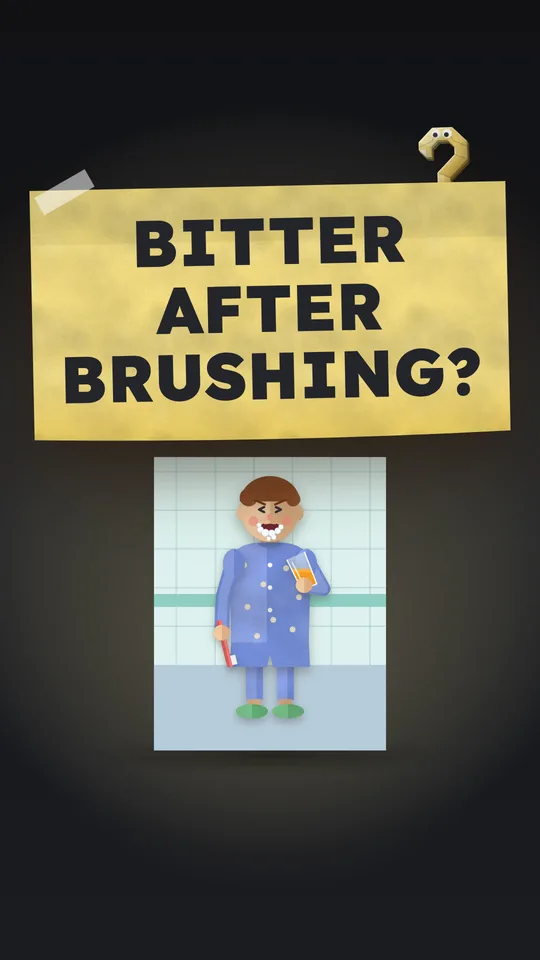
Many toothpastes contain sodium lauryl sulfate (SLS), a detergent that makes the foam1, 2, 4. In a 1980 experiment, volunteers held a dilute (0.05%) SLS solution in their mouths for one minute. Afterwards, sweet, salty and bitter tastes were a little weaker, and sour citric acid picked up “a distinct bitter taste”3, 4. Orange juice is sweet but also contains citric acid4, so right after brushing it can taste less sweet and more bitter4. Exactly how SLS does this is not fully settled3, 8, but the effect wears off4.
The foam maker
A clinical study of toothpastes puts it simply: “The most widely used surfactant in dentifrices is sodium lauryl sulfate (SLS)”1. SLS makes toothpaste foam1, 2 and, as a detergent, helps remove plaque, the sticky film of germs on teeth1, 4.
Like dish soap, it breaks up fat4. That matters for taste: the outer layer of every cell, including taste cells, is made of fats called lipids4.
What the 1980 experiment found
Three researchers3 tested SLS with seven student volunteers at Yale4. The volunteers tasted strong solutions of sugar, salt, sour citric acid and bitter quinine, before and after holding a 0.05% SLS solution in their mouths for one minute4.
Sugar, salt and quinine tasted a little weaker afterwards3, 4. Citric acid stayed just as sour, but something new appeared: “The sourness of citric acid is unaffected, but it is augmented by a distinct bitter taste”3. One of the researchers later called this “the most important change”4.
Fun detail: the same study compared SLS with gymnemic acid3, which comes from the leaves of an herb from southern and central India and is known to make sweet things taste less sweet9.
Is it just the mint?
Mint and orange may seem like a bad match. But one of the 1980 researchers writes: “It’s not just that minty tastes clash with sweet ones”4. A science magazine says the same: “it isn’t just the mix of citrus and mint”5. Note the word “just”: these sources do not say the mint plays no part at all.
How does it work? What’s known and what’s a guess
Measured: SLS weakens several tastes and adds bitterness to citric acid3. Not proven: the 1980 researchers suggested that SLS disturbs the membranes of taste cells, but they did not rule out a direct effect on the taste receptors themselves3.
A popular explanation says SLS suppresses sweet receptors and “destroys compounds in the saliva called phospholipids, which block bitter receptors”6. In experiments on frogs’ taste nerves, a substance built from phosphatidic acid and a protein selectively dampened responses to bitter substances7, but we found no study that tested this step with toothpaste. One news report said it plainly, even though it mixed up some terms elsewhere: “scientists aren’t sure exactly why, or how, this happens”8.
How long does it last?
The effect is temporary, “lasting only a few minutes,” according to one of the original researchers4. A 1988 newspaper report called it “very brief — on the order of minutes”10. Because sweet, salty and bitter all tasted a bit weaker in the test, the effect is not limited to orange juice3, 4, though it has a nickname: the “orange juice effect”1.
Toothpastes without SLS exist. In one study, a paste without SLS worked as well against plaque as a regular one, but users rated the taste and foam of the SLS paste higher1.
What we're not sure about
How exactly SLS makes sour things taste bitter is not proven; the membrane and phospholipid explanations are ideas, not measured steps3, 6, 7.
We found no measurement of how long the effect lasts; “a few minutes” is how one researcher and a 1988 news report describe it4, 10.
The 1980 test was small (seven people) and used pure taste solutions, not orange juice4; the summary of the paper we could read does not mention orange juice3.
How much the mint flavour itself adds has, as far as we could find, not been measured.
Sources
- Sälzer S, Rosema NA, Martin EC, Slot DE, Timmer CJ, Dörfer CE, Van der Weijden GA: The effectiveness of dentifrices without and with sodium lauryl sulfate on plaque, gingivitis and gingival abrasion – a randomized clinical trial. Clinical Oral Investigations 20(3):443–450, 2016 (full text)
- Royal Society of Chemistry: Tricking taste buds with toothpaste. RSC Education, Primary Science, undated (full text)
- DeSimone JA, Heck GL, Bartoshuk LM: Surface active taste modifiers: a comparison of the physical and psychophysical properties of gymnemic acid and sodium lauryl sulfate. Chemical Senses 5(4):317–330, 1980 (abstract only)
- Bartoshuk L: Why does orange juice taste bad after you brush your teeth? The Conversation, 5 January 2026 (full text)
- Scientific American: Why Toothpaste Makes Orange Juice Taste Bad (video page), July 2013 (page text only, video not watched)
- Davies E: Why does orange juice taste bad after tooth brushing? BBC Science Focus Magazine, undated (full text)
- Katsuragi Y, Kashiwayanagi M, Kurihara K: Specific inhibitor for bitter taste: inhibition of frog taste nerve responses and human taste sensation to bitter stimuli. Brain Research Protocols 1(3):292–298, 1997 (abstract only)
- Dahl M: Why does toothpaste make orange juice taste so weird? SBS News (first published by Science of Us), 10 October 2014 (full text)
- Hudson SD, Sims CA, Odabasi AZ, Colquhoun TA, Snyder DJ, Stamps JJ, Dotson SC, Puentes L, Bartoshuk LM: Flavor Alterations Associated with Miracle Fruit and Gymnema sylvestre. Chemical Senses 43(7):481–488, 2018 (full text)
- The Washington Post: The bitter truth about toothpaste and OJ. 26 April 1988 (archive text)
Researched and independently fact-checked on 19 November 2026. Found a mistake? Tell us at querigami@gmail.com and we will correct it here.
Even careful research can contain errors, and science keeps moving. This article is for general information and education only, not professional advice. We link to sources so you can check them yourself, but we are not responsible for the content of external websites.