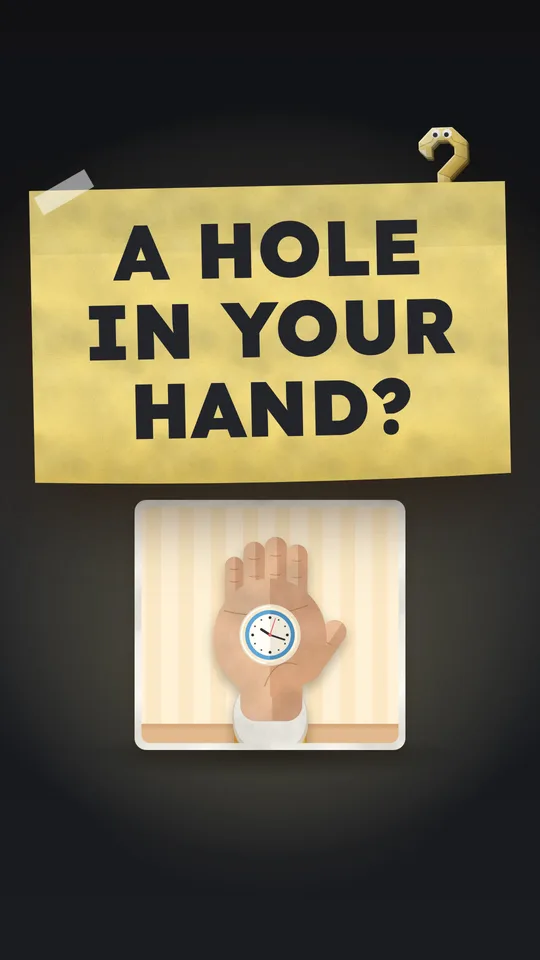
Roll up a sheet of paper, look through it with one eye, hold your open hand beside it, and a hole appears in your palm. Your hand is fine. What you are seeing is your brain settling a disagreement between your two eyes.
Two eyes, one picture
Normally your two eyes see the same scene from slightly different angles, and your brain merges the two views into a single picture with depth4. The tube trick breaks this teamwork on purpose: one eye sees the faraway view at the end of the tube, while the other eye sees your palm in the same spot1.
When the two images at one place are too different to merge, scientists call it binocular rivalry: the brain cannot fuse what the two eyes report5. Instead of blending them into a mix, the brain tends to let one image win and push the other out of view5, 8. Some explanations say your eyes and brain 'add' the two images together1. That is a simplification: researchers describe rivalry as one eye's view replacing the other's, 'rather than mixing the views of the two eyes'10.
Why the hole wins
In the tube trick, the circle of distant scenery usually beats the matching patch of your palm. So the palm seems to have a hole while the rest of your hand stays visible8. One reason: for the eye behind the tube, almost everything is the dark inside of the tube, and the bright circle at the end is the one bright spot, so your brain pays extra attention to it9. In general, brighter images, higher contrast, movement and fine detail tend to stay visible longer5. One popular explanation adds that the nearby hand is the weaker image because it is out of focus while you look into the distance8. That may help, but it is only one possible reason. Movement matters too. In a related Exploratorium trick, a moving hand makes parts of a still face disappear, because 'your brain is very sensitive to changes and motion'2.
The contest is not frozen. In lab experiments, what people see typically switches back and forth every few seconds as long as they keep looking, about every 2 to 3 seconds in one review, and how long each view lasts depends on the pictures5, 10. With larger images the winner can break into a patchwork, with pieces of both views visible at once5.
Does it matter which eye looks through the tube?
Some people find the effect stronger with one eye. The Exploratorium explains this with eye dominance: your brain may slightly prefer information from one eye, a bit like being right- or left-handed1. But the 'dominant eye' is not one fixed thing. In one study, an aiming test found right-eye dominance in 71% of people and a blur-based test in only 54%. The two tests picked the same eye only half the time7.
Having a dominant eye doesn't mean the other eye is switched off: both eyes feed the picture, and which one wins can change from spot to spot and from moment to moment5.
A puzzle from 1838
In 1838 Charles Wheatstone published the first description of his stereoscope, a device that shows each eye its own picture4. He showed different letters, A and S, to the two eyes and saw them take turns. He noted that 'it does not appear to be in the power of the will to determine the appearance of either of the letters'3. In 1844 his rival David Brewster called the disappearing and reappearing images 'ocular equivocation'3.
Our eyes often get slightly different images in everyday life, for example around the edges of nearby objects. Even so, noticeable rivalry is rare outside the lab6.
What we're not sure about
Where in the brain the contest is decided is still debated. Some evidence points to early stages that handle each eye separately, other evidence to later stages that compare whole patterns5.
How and where the switches are triggered is still not fully understood5.
In the sources we read, the claim that eye dominance explains the left-right difference in the tube trick comes from a science-museum explanation, not from a measurement of the trick itself1, 7.
In a computer simulation of a simple room with two objects, 10 to 30% of the tested arrangements gave the eyes differences larger than the brain is thought to be able to fuse. Researchers do not yet know why we so rarely notice rivalry in daily life6.
Sources
- Exploratorium: Hole In Your Hand – Science Snack (undated)
- Exploratorium: Cheshire Cat – Science Snack (undated)
- Nicholas J. Wade: Ocular Equivocation: The Rivalry Between Wheatstone and Brewster, Vision 3(2):26 (2019)
- The Royal Society: 180 years of 3D (2018)
- Wolf & Hochstein: High-Level Binocular Rivalry Effects, Frontiers in Human Neuroscience 5:129 (2011)
- Han, Blake, Aubuchon & Tadin: Binocular rivalry under naturalistic geometry: Evidence from worlds simulated in virtual reality, PNAS Nexus 3(2) (2024)
- J. S. Pointer: Sighting versus sensory ocular dominance, Journal of Optometry 5:52–55 (2012)
- IFLScience: This Bizarre Illusion Makes You See A "Hole" In Your Hand (undated)
- Science World: Hole in the Hand (undated)
- Maier, Panagiotaropoulos, Tsuchiya & Keliris: Introduction to Research Topic – Binocular Rivalry: A Gateway to Studying Consciousness, Frontiers in Human Neuroscience 6:263 (2012)
Researched and independently fact-checked on 21 November 2026. Found a mistake? Tell us at querigami@gmail.com and we will correct it here.
Even careful research can contain errors, and science keeps moving. This article is for general information and education only, not professional advice. We link to sources so you can check them yourself, but we are not responsible for the content of external websites.