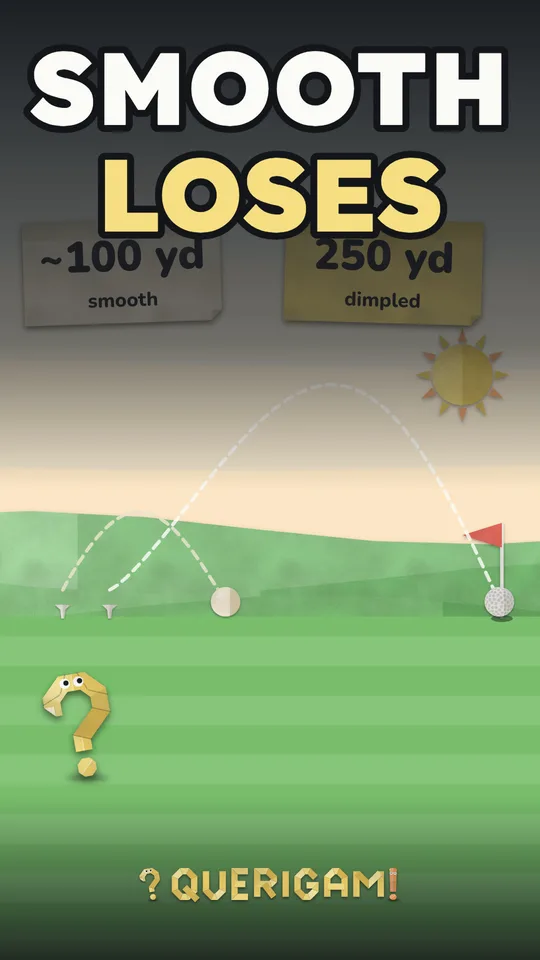
Golf balls have dimples because, at the speeds of a golf shot, a slightly rough ball slips through the air more easily than a smooth one1. The dimples stir the thin layer of air hugging the ball into turbulence, which clings on a little longer and shrinks the drag-causing wake behind it2, 3. The payoff: about half the drag, more lift from a spinning ball, and twice the distance or more2, 3, 5.
The bumpy ball wins
NASA notes that a smooth golf ball travels less than half the distance of a dimpled one3. A Princeton engineering page puts numbers on it: a driver shot can easily carry a dimpled ball 250 yards (about 230 metres), but the same shot with a smooth ball only about 100 yards (about 90 metres)5.
Most golf balls have between 300 and 500 dimples, on average only about 0.25 millimetres (0.010 inch) deep2. Changing that depth by just 0.001 inch can radically change how far the ball flies2.
A thin skin of air decides everything
A flying ball leaves a turbulent, low-pressure wake behind it, and the bigger the wake, the bigger the drag2. Everything hinges on the boundary layer, a very thin layer of air right at the surface: where it separates from the ball, a pressure imbalance creates drag and slows the ball down3.
Dimples make the boundary layer turbulent, which keeps it attached longer and delays separation3. The air follows the surface a little farther around the back, the wake shrinks, and a dimpled ball ends up with about half the drag of a smooth one2. Measurements just above the dimples show the detail: inside each dimple the air briefly lifts off and lands again, churning up strong turbulence, and the reattached air carries enough momentum to push on against the rising pressure at the rear4.
The right speed and the right spin
A roughened ball turns turbulent at a lower Reynolds number (a ratio that rises with speed and size) than a smooth one, and only in a small range does the rough ball have less drag1. A golf ball's size and speed fall right inside that range1. In that range the drag of a dimpled sphere drops suddenly, to less than half that of a smooth sphere at the same Reynolds number6.
Backspin makes the air pressure under the ball higher than on top, pushing it up2. Two golf-ball aerodynamicists estimate that the dimples provide about half of a golf ball's lift2.
Found by accident, still not required
Golfers realised perhaps as early as the 1800s that balls with indented surfaces flew better than smooth ones, and hand-hammered gutta-percha balls were on sale by at least the 1860s7. In 1905 the Englishman William Taylor applied for a British patent on a ball with shallow, evenly spread round cavities12, and he received a US patent for it in 190813.
Oddly, today's rules do not demand dimples: they cover general form and materials, weight, size, spherical symmetry, launch speed and overall distance8.
What we're not sure about
How much farther a dimpled ball flies. Estimates range from about twice2, 3 to about two and a half times5. A claim of "approximately four times" on an engineering-firm blog cites a NASA page that contains no such figure10, 11.
Whether dimples always cut drag. Most sources say they do, by about half2 or more6, but only in the speed range of a golf shot1. An older physics FAQ claims they "do increase drag slightly" and help through lift instead9, and a 2019 simulation found that the dimples add a small drag penalty of their own6; at much higher speeds, a dimpled sphere has two to three times the drag of a smooth one6.
How the lift is shared. The estimate that dimples supply about half the lift comes from a single source written by golf-ball engineers2; we found no independent measurement.
Sources
- NASA Glenn Research Center (page last updated 2025): Drag of a Sphere. Beginners Guide to Aeronautics, NASA
- Veilleux, T. & Simonds, V. (2005; answer first posted 2004): How do dimples in golf balls affect their flight? Scientific American (Ask the Experts)
- NASA Ames Research Center (2016): NASA Turns the Super Bowl Into Lesson in Aerodynamics. NASA
- Choi, J., Jeon, W.-P. & Choi, H. (2006): Mechanism of drag reduction by dimples on a sphere. Physics of Fluids 18(4), 041702, doi:10.1063/1.2191848 (abstract, read via Seoul National University repository)
- Smits, A. J. (n.d.): Golf Balls, Cricket Balls and Tennis Balls. Princeton University, Aerodynamics of Bicycles pages (read via web.archive.org copy of Dec 2023)
- Beratlis, N., Balaras, E. & Squires, K. (2019): On the origin of the drag force on dimpled spheres. Journal of Fluid Mechanics 879, 147ff., doi:10.1017/jfm.2019.647 (abstract)
- Ogg, S. S. (2001): Golf ball dimples with curvature continuity. US Patent 6,331,150 B1, section 'Description of the Related Art'
- The R&A and USGA (current edition): Rules of Equipment, Part 4 - Conformance of Balls. The R&A
- DeForest, C. (1993, updated 1997): Why are Golf Balls Dimpled? Usenet Physics FAQ, hosted at UC Riverside
- CNR Design (2026): Golf Ball Aerodynamics. CNR Services International (engineering-firm blog; cited only for a contradiction)
- NASA Spinoff (1995): Golf Aerodynamics. NASA Technology Transfer Program
- Taylor, W. (1905, published 1906): An Improvement in Golf Balls. British patent GB190518668A
- Taylor, W. (1908): Golf-ball. US patent 878,254
Researched and independently fact-checked on 28 October 2026. Found a mistake? Tell us at querigami@gmail.com and we will correct it here.
Even careful research can contain errors, and science keeps moving. This article is for general information and education only, not professional advice. We link to sources so you can check them yourself, but we are not responsible for the content of external websites.