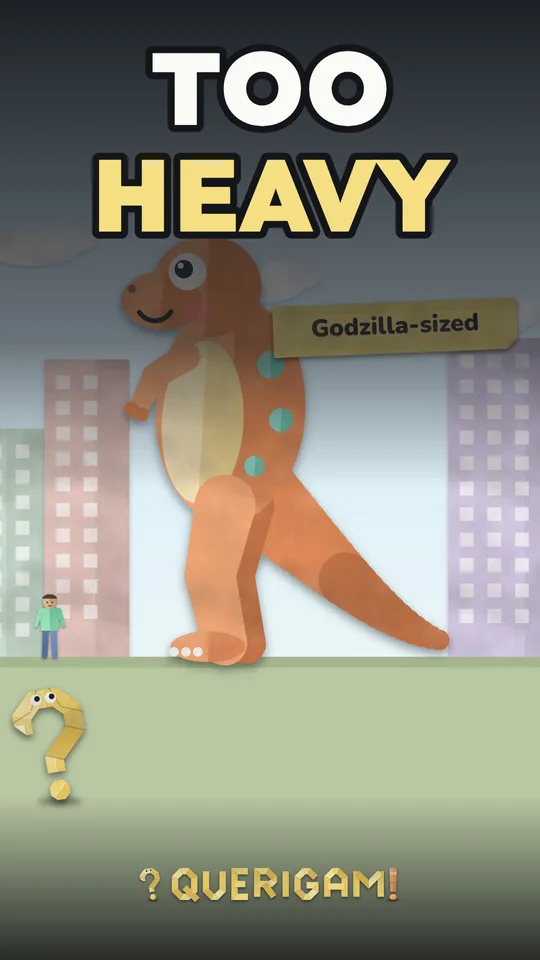
Making an animal bigger does not simply make it stronger: its weight grows much faster than the cross-section of its bones2. A monster 30 times your height, built like you, would load each square inch of bone 30 times as much as yours, far beyond the roughly tenfold load that, according to Haldane, a human thigh-bone can take2.
Galileo's oversized bone
In 1638, Galileo Galilei argued that it would be impossible to build "the bony structures of men, horses, or other animals" so that they held together "if these animals were to be increased enormously in height", unless the bones were made of a harder material or grew far thicker1. He sketched "a bone whose natural length has been increased three times" and whose thickness had to be "multiplied" to do the same job. "From the figures here shown you can see how out of proportion the enlarged bone appears," he wrote1.
The square-cube law
Make a body k times bigger in every direction and its weight grows with k × k × k, but its bone cross-section, which sets how much load the bones can carry, only with k × k. So every square inch of bone carries k times more. In 1926, Haldane worked this out for the giants Pope and Pagan from Pilgrim's Progress: ten times as high as the hero Christian, "so that their total weight was a thousand times his", yet "the cross sections of their bones were only a hundred times those of Christian"2. And "as the human thigh-bone breaks under about ten times the human weight", they "would have broken their thighs every time they took a step"2.
A monster 30 times your height
Picture a monster about 50 meters tall: roughly a 15-storey building (at about 3.3 meters per floor) and about 30 times a 1.7-meter person. (The Godzilla of Godzilla Minus One, from 2023, is officially 50.1 meters tall, according to Toho7.)
Now assume it is built like you. Its bones get 30 × 30 = 900 times your bone cross-section, but its weight goes up 30 × 30 × 30 = 27,000 times, about 1,900 tonnes if you weigh 70 kilograms. Each square inch of its bone would carry 30 times the load yours does. By Haldane's rough tenfold rule2, its thigh-bones would be loaded about three times past breaking just standing still: on paper, it would collapse before its first step. Modern measurements leave little room either: in mammals running hard, peak limb-bone stress reaches about a quarter to half of the breaking stress, a safety factor of only 2 to 43, 8.
Ants, elephants and you
Going small flips the rule. "The smaller the body the greater its relative strength," Galileo noted, guessing that a small dog could carry two or three dogs its own size, while a horse "could not carry even one"1. In a 2019 experiment, leaf-cutter ants could lift at most, on average, 8.78 times their own body mass4.
Haldane wrote that a gazelle grown large would break its bones unless its legs became "short and thick, like the rhinoceros", or long and slanted like a giraffe's2. Biomechanist Andrew Biewener found that large mammals run with more upright limbs, which greatly reduces the forces on their bones3. Elephants, even at their fastest, never have all four feet off the ground at the same time5.
What we're not sure about
Real animals don't scale up evenly. From mouse to horse size, a more upright posture keeps peak bone stress about the same3, 8; beyond roughly 300 kilograms, bones grow relatively thicker and the animals become less athletic8. So 'k cubed versus k squared' is a starting point, not the whole story.
Some sauropod dinosaurs topped 50 tonnes even by conservative estimates and still walked, on "massive, columnar limbs", with air spaces in their backbones lightening their long necks6.
Movie monsters don't have to follow these rules. That's what makes movie monsters magic.
Sources
- Galilei, G. (1638): Dialogues Concerning Two New Sciences, Second Day, transl. H. Crew & A. de Salvio. Macmillan 1914; Dover reprint 1954, pp. 130–131 (transcription)
- Haldane, J. B. S. (1926): On Being the Right Size. Harper's Magazine, March 1926; reprinted in Cabinet Magazine 28 (2007/2008)
- Biewener, A. A. (1989): Scaling body support in mammals: limb posture and muscle mechanics. Science 245, 45–48
- Segre, P. S. & Taylor, E. D. (2019): Large ants do not carry their fair share: maximal load-carrying performance of leaf-cutter ants (Atta cephalotes). Journal of Experimental Biology 222, jeb199240
- University of Colorado Boulder (2003): Can Elephants Really Run? Yes And No, Say Researchers (on Hutchinson, Famini, Lair & Kram, Nature 422, 493–494)
- Sander, P. M. et al. (2011): Biology of the sauropod dinosaurs: the evolution of gigantism. Biological Reviews 86, 117–155
- Toho: Godzilla (2023), Monsterpedia, godzilla.com (official Toho site): "Largest Height 50.1 Meters"
- Biewener, A. A. (1990): Biomechanics of mammalian terrestrial locomotion. Science 250, 1097–1103
Researched and independently fact-checked on 4 November 2026. Found a mistake? Tell us at querigami@gmail.com and we will correct it here.
Even careful research can contain errors, and science keeps moving. This article is for general information and education only, not professional advice. We link to sources so you can check them yourself, but we are not responsible for the content of external websites.