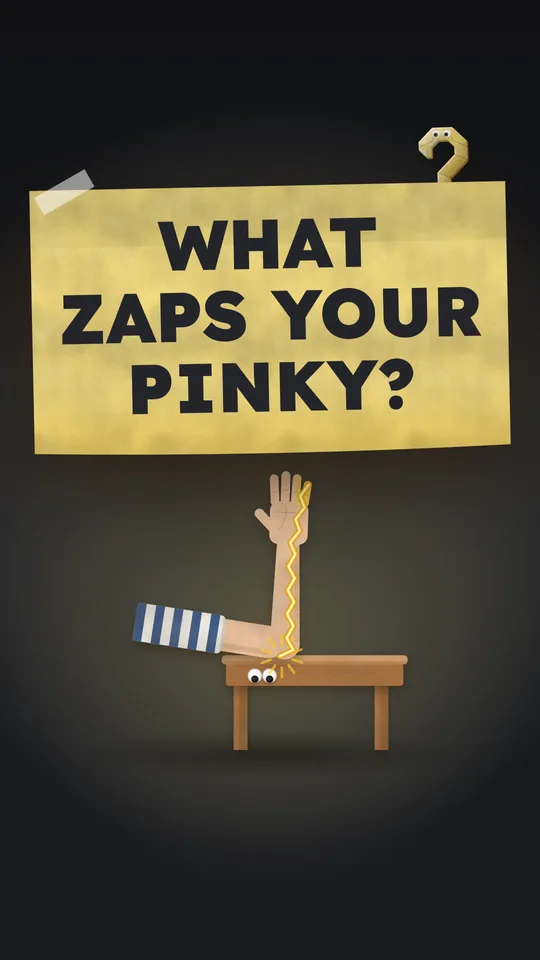
Your funny bone is not a bone at all. It is the ulnar nerve, which Cleveland Clinic calls "commonly known as your funny bone"1, 2. At the elbow it runs behind a bump on the upper-arm bone, close to the skin, with very little soft tissue to protect it7, 8. A knock squeezes the nerve, and because it carries feeling from the little finger and half of the ring finger, that is where the jolt shows up1, 5, 7. The "humerus / humorous" joke may be part of the name's story, but nobody can prove it is the origin3, 4.
The bone that isn't
You bang your elbow on a door frame and a buzzing jolt shoots down your arm. Everyone calls that spot the funny bone, so you would expect a bone. There isn't one. The Cleveland Clinic says the ulnar nerve "is commonly known as your funny bone", and that the funny bone "isn't a bone at all"1. McGill University's Office for Science and Society puts it the same way: the pain comes from hitting a nerve, not a bone2. The American Academy of Orthopaedic Surgeons explains that the spot where the nerve runs under the medial epicondyle is what people call the funny bone7.
A nerve with very little cushion
The ulnar nerve is long. It runs from the base of the neck to the tips of the little finger and ring finger3. Along much of its route it is protected by layers of muscle, fat and other tissue2. At the elbow the protection thins out. The nerve passes through the cubital tunnel, a valley between the bony point of the elbow and a second bump on the humerus called the medial epicondyle2, 9. Cleveland Clinic says it runs "underneath the first layer of skin near your elbow"1, and the anatomy library Kenhub describes it there as lying directly under the skin and easy to feel8. The AAOS notes that it travels through a narrow space "with very little soft tissue to protect it"7.
So when you hit the spot, you aren't hitting padding. The knock pinches the nerve itself1, and an orthopedic clinic describes it as the nerve being compressed against the humerus5, 6.
Why the fingers, not the elbow
The ulnar nerve carries feeling from the little finger and the half of the ring finger closest to it1, 7, 8. Because this nerve is the one that carries feeling from those fingers, a jolt to it is felt there1, 5. The AAOS lists an electric shock sensation and numbness in the little and ring fingers after a direct blow to the inside of the elbow7, and McGill says the tingling runs down your arm all the way into your fingers2. Cleveland Clinic describes the feeling as a shock-like tingling or burning1.
So why "funny"?
The tempting answer is a pun. The upper-arm bone is the humerus, which sounds like "humorous", and The Conversation calls the name a straight pun3. But the evidence is thinner than the joke. The author of Word Histories, who traced early uses, writes that early use was "perhaps partly punning" on the two words, and points to an 1827 London newspaper line asking what the surgeon means by "the os humorous"4. That makes the pun a possible part of the story, not a certainty4. In older American English the same spot was also called the "crazy bone", and a 1907 Webster's dictionary lists both names4.
A clinic blog offers a plainer idea: the feeling is often described as funny because it is unusual and unexpected, not because it makes anyone laugh5. McGill mentions both ideas2.
What we're not sure about
Where the name comes from. The humerus pun is popular3, and Word Histories finds it possible as a partial cause4. Other sources point to the odd feeling instead2, 5. No source we read proves which came first.
When the phrase first appeared. The Conversation (2013) cites the Oxford English Dictionary's first recorded use in an 1842 poem3. Word Histories (2021) later found it in two song collections from 1826 and 18274, so the name is at least that old.
Exactly how much cushion there is. Several sources say the nerve gets pinched or compressed against the bone1, 5, 6, but we found no measured thickness of the tissue over it, only descriptions like "very little soft tissue"7 and "much less protection"2.
Sources
- Cleveland Clinic (2021): Ulnar Nerve (Funny Bone): What Is It, Branches & Function. Cleveland Clinic
- McGill Office for Science and Society (undated): The Funny Bone Is Not a Bone. McGill University
- The Conversation (2013): Explainer: what is the funny bone? The Conversation
- Tréguer, P. (2021): funny bone: meaning and origin. Word Histories
- Syracuse Orthopedic Specialists (2024): The Curious Case of the "Funny Bone". SOS Bones
- Wikipedia (2026): Ulnar nerve. Wikimedia Foundation
- American Academy of Orthopaedic Surgeons (undated): Ulnar Nerve Entrapment at the Elbow (Cubital Tunnel Syndrome). OrthoInfo, AAOS
- Kenhub (2023): Ulnar nerve. Kenhub
- TeachMeSeries (2026): The Ulnar Nerve. TeachMeAnatomy
Researched and independently fact-checked on 13 November 2026. Found a mistake? Tell us at querigami@gmail.com and we will correct it here.
Even careful research can contain errors, and science keeps moving. This article is for general information and education only, not professional advice. We link to sources so you can check them yourself, but we are not responsible for the content of external websites.