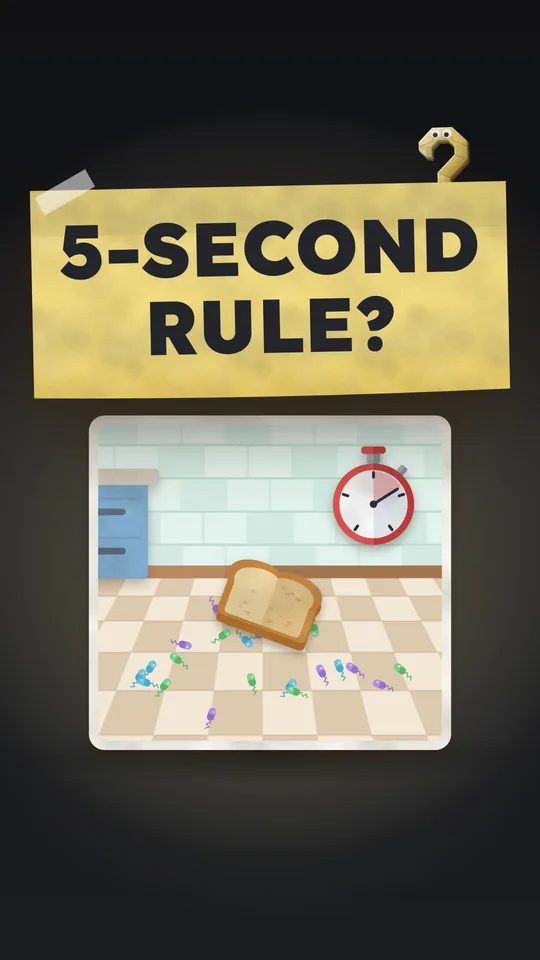
In lab tests, bacteria jumped onto dropped food in less than a second, and the type of food and the surface it landed on mattered at least as much as how long it lay there.
Putting the rule to the test
The five-second rule claims that food dropped on the floor stays clean if it is picked up quickly, because germs supposedly need time to climb aboard. Scientists have tested this in the lab by coating surfaces with a known amount of bacteria and then dropping food onto them1, 3.
A test published by Rutgers University researchers in 2016 used four surfaces (stainless steel, ceramic tile, wood and carpet), four foods (watermelon, bread, buttered bread and gummy candy) and four contact times: less than one second, 5, 30 and 300 seconds1, 2. Every combination was repeated 20 times, giving 2,560 measurements1, 2. The bacterium was Enterobacter aerogenes, a harmless relative of Salmonella that sticks to surfaces in a similar way1, 7. Each surface carried roughly ten million bacteria, dried on for five hours1.
Faster than a blink
The clearest result: some bacteria transfer in under one second1, 2. The Rutgers authors write that this happens "instantaneously," disproving the five-second rule1. An earlier study from Clemson University, published in 2007, used Salmonella Typhimurium on tile, wood and carpet and found it could reach the test foods, bologna and bread, "almost immediately on contact"3. A 2003 experiment at the University of Illinois saw E. coli move from tile to cookies and gummy bears within five seconds, though that work was never published in a peer-reviewed journal1, 6.
Time still plays a role. In the Rutgers data, longer contact usually meant more bacteria on the food1, 7. For watermelon, contact time made no significant difference1. A 2014 study at Aston University also called time "a significant factor"5.
Wet food, soft floor
What the food is made of matters a lot. Watermelon picked up the most bacteria, between about 0.2 and 97 percent of those on the surface, and gummy candy the least, about 0.1 to 62 percent1, 2. Bread (about 0.02 to 94 percent) and buttered bread (about 0.02 to 82 percent) were similar to each other, but their results varied more1.
The researchers suggest that moisture is probably the main driver1, 2. Gummy candy was much drier than the other foods: its water activity, a measure of how much water is available, was 0.72, compared with at least 0.95 for the rest1. They also suggest that watermelon may have a flatter, more even surface at the microscopic level1.
Perhaps surprisingly, carpet passed on very few bacteria, in some Rutgers tests only about 0.2 percent, far less than tile or stainless steel, while wood gave mixed results1, 7. The Clemson team measured less than 0.5 percent transfer from carpet to bologna, compared with 5 to 68 percent from wood and tile3, and the Aston team also found carpet the least likely surface to pass on bacteria4, 5. One explanation is that bacteria cling to or sink into carpet fibers1.
Germs that wait
The Clemson study also asked how long bacteria last on a dry surface. After 28 days, roughly 30 to 300 colony-forming units of Salmonella per square centimeter were still present on tile3. The longer the bacteria had been sitting on a surface, from 2 up to 24 hours, the fewer reached the food3. The authors concluded that Salmonella can survive up to four weeks on dry surfaces in numbers high enough to transfer to food3.
Two headlines, one question
The Aston study was reported in 2014 under the headline "Five-second food rule exists, new research suggests"4. Final-year biology students did the work, and the results were announced in a university press release1, 4, 5. At the time, the team said it was preparing the work for submission to a peer-reviewed journal6. The Rutgers study, published in Applied and Environmental Microbiology, called the rule "a significant oversimplification"1, 2. Yet both found that shorter contact generally means fewer bacteria. They differ mainly in how they read that result1, 4.
What we're not sure about
Lab floors are not everyday floors. The tests used surfaces carrying around ten million bacteria1. The Rutgers authors did not vary that starting amount and note it may affect the result; earlier work found that a larger dose led to a lower transfer rate1. The 2003 Illinois project reportedly found no significant contamination on public floors it sampled8.
Pressure was not tested. Whether food that lands hard picks up more bacteria than food that lands gently is open1.
Each study used only one or two kinds of bacteria: Rutgers a harmless stand-in, Clemson Salmonella, Aston E. coli and Staphylococcus aureus1, 3, 4. Other microbes may behave differently, and which ones are on a given floor varies5.
The Clemson abstract reports only a 5-second contact time. According to the Rutgers authors, longer contact (5, 30, 60 seconds) increased transfer there only when the bacteria had been on the surface for at least 8 hours1. Wikipedia reports a roughly tenfold increase for one minute of contact8. We could not check this against the full paper3.
Sources
- Miranda RC, Schaffner DW (2016): Longer Contact Times Increase Cross-Contamination of Enterobacter aerogenes from Surfaces to Food. Applied and Environmental Microbiology 82(21):6490-6496 (full text, PMC)
- Rutgers University press release (via ScienceDaily, 9 Sep 2016): Researchers debunk 'five-second rule'
- Dawson P, Han I, Cox M, Black C, Simmons L (2007): Residence time and food contact time effects on transfer of Salmonella Typhimurium from tile, wood and carpet: testing the five-second rule. Journal of Applied Microbiology 102(4):945-953 (abstract)
- Aston University press release (via ScienceDaily, 10 Mar 2014): Dropped your toast? Five-second food rule exists, new research suggests
- Medical Xpress (Mar 2014, credited to Aston University): Research suggests the five-second rule is real
- Scientific American: Fact or Fiction?: The 5-Second Rule for Dropped Food
- Science News (2016): It's time to retire the five-second rule
- Wikipedia: Five-second rule (secondary, used only for the 2003 floor sampling and the contact-time contradiction)
Researched and independently fact-checked on 22 November 2026. Found a mistake? Tell us at querigami@gmail.com and we will correct it here.
Even careful research can contain errors, and science keeps moving. This article is for general information and education only, not professional advice. We link to sources so you can check them yourself, but we are not responsible for the content of external websites.