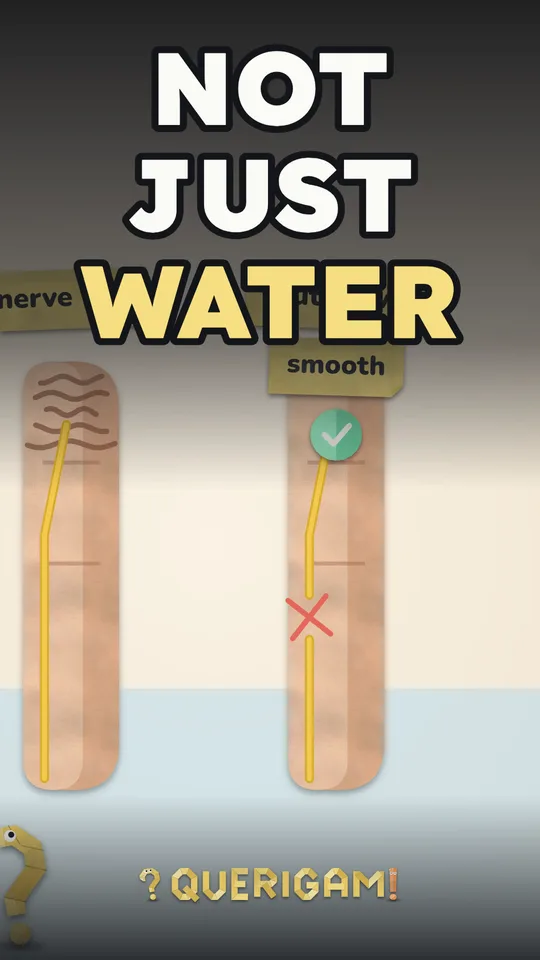
Pruney fingers are not just waterlogged skin. Fingers with a cut or blocked nerve stay smooth in water3, 6. Wrinkling goes along with the blood vessels in the fingertip pad tightening, so the pad loses volume and the skin on top folds1, 2. Water seems to set off this response, possibly by seeping in through sweat ducts, but whether the wrinkles improve our grip is still disputed2, 5, 6, 7.
Not just soggy skin
The obvious guess is that skin soaks up water like a sponge and swells. For a long time that was the standard explanation: osmotic swelling of the outermost skin layer5. But in the 1930s, the researchers Lewis and Pickering noticed that fingers whose nerve supply was blocked or cut did not wrinkle3, 6. If wrinkling were just passive soaking, a missing nerve should make no difference. A recent review sums up their conclusion: wrinkling is an active response of the sympathetic nervous system, not simple water absorption3.
In 1973, Seamus O'Riain described a simple warm-water test of nerve function in the hand. He reported that its results matched what surgeons found during operations11. Versions of this 'wrinkle test' are still studied today3.
Your fingertip deflates
In 2003, researchers in Singapore measured blood flow in volunteers' hands while they soaked them. As the skin wrinkled, blood flow in the finger arteries and skin dropped. Their verdict: wrinkling is 'a function of digit pulp vasoconstriction', a narrowing of the blood vessels in the fingertip pad1.
Picture the fingertip pad as a cushion under a sheet of skin. When its vessels tighten, the cushion loses volume and the skin on top has to fold2, 5. In a striking test with 25 volunteers, EMLA, a numbing cream that also narrows blood vessels, was put on the fingertips. It caused nearly the same wrinkling and a nearly identical drop in blood flow as soaking in water12.
So what does the water do? It probably seeps in through the many sweat ducts of the palms and soles and changes the salt balance in the skin, which may push the nerves to tighten the vessels2, 3. In a study of 14 volunteers, saltier solutions slowed wrinkling down15. Swelling is not entirely off the hook, though. A computer model found that swelling of the outer layer plus shrinking of the deeper layers creates wrinkles far more easily than either one alone10.
Timing, temperature and a repeating pattern
Warmth helps. Lewis and Pickering saw faster wrinkling in warm water and none in cold3. A 1997 study named 40°C as the best temperature for testing hands, with wrinkling expected after about 3.5 minutes8. Full wrinkling takes longer: many experiments soak hands for 30 minutes5, 6, 9, and a review notes that most healthy people show wrinkling after 30 minutes3. It happens on the hairless skin of both hands and feet5.
The wrinkles are temporary. In one experiment they faded 10 to 20 minutes after people washed and dried their hands5. In a small 2025 study of three people, the wrinkles came back in nearly the same pattern a day or more later. The authors suspect this is because the blood vessels underneath stay in place9.
Built for grip? The jury is out
If the body actively makes wrinkles, could they be useful? In 2011, Mark Changizi and colleagues proposed that they work like 'rain treads', a bit like the tread on a tire: channels that drain water away when we grip something wet4.
In 2013, a Newcastle University team14 had 20 people move marbles and weights with smooth or wrinkled fingers. With wrinkles, moving submerged objects took 12 per cent less time, while dry objects showed no difference5. In 2014, a Berlin team tested 40 people with a similar task. They found no advantage and no change in touch sensitivity6, 13. A 2021 study of 516 people measured grip force instead of speed. Wet, smooth fingers squeezed harder than dry ones, while wrinkled fingers gripped much like dry fingers7.
What we're not sure about
Do wrinkles really improve grip? The speed tests disagree5, 6, and one large grip-force study points to a benefit7.
Are wrinkles an evolved adaptation or just a side effect of tightening blood vessels? The Berlin team found no support for an adaptation6. Changizi's team argues for one4, and the grip-force study calls it a possible adaptive reason7.
If wrinkles help, why aren't our fingertips wrinkled all the time? The Newcastle team suggested costs such as losing touch sensitivity or snagging on objects5. The Berlin team found no loss of touch acuity in wrinkled fingers6, so the 'cost' question is still open, and snagging has not been tested.
Exactly how water entering the skin switches on the nerve response is still a hypothesis2, 3.
The finding that wrinkle patterns repeat rests on just three people so far9.
Sources
- Wilder-Smith EPV, Chow A (2003): Water-immersion wrinkling is due to vasoconstriction. Muscle & Nerve 27(3): 307-311 (doi 10.1002/mus.10323)
- Wilder-Smith EPV (2004): Water immersion wrinkling - physiology and use as an indicator of sympathetic function. Clinical Autonomic Research 14(2): 125-131 (doi 10.1007/s10286-004-0172-4)
- Hernandez Fustes OJ, Kay CSK, Lorenzoni PJ, Ducci RDP, Rodrigues PRVP, Barsottini OGP, Scola RH (2026): The skin-wrinkling test: principles and clinical applications. Arquivos de Neuro-Psiquiatria 84(7): s00461827046 (doi 10.1055/s-0046-1827046)
- Changizi M, Weber R, Kotecha R, Palazzo J (2011): Are wet-induced wrinkled fingers primate rain treads? Brain, Behavior and Evolution 77(4): 286-290 (doi 10.1159/000328223)
- Kareklas K, Nettle D, Smulders TV (2013): Water-induced finger wrinkles improve handling of wet objects. Biology Letters 9(2): 20120999 (doi 10.1098/rsbl.2012.0999)
- Haseleu J, Omerbasic D, Frenzel H, Gross M, Lewin GR (2014): Water-induced finger wrinkles do not affect touch acuity or dexterity in handling wet objects. PLOS ONE 9(1): e84949 (doi 10.1371/journal.pone.0084949)
- Davis NJ (2021): Water-immersion finger-wrinkling improves grip efficiency in handling wet objects. PLOS ONE 16(7): e0253185 (doi 10.1371/journal.pone.0253185)
- Cales L, Weber RA (1997): Effect of water temperature on skin wrinkling. Journal of Hand Surgery (Am) 22(4): 747-749 (doi 10.1016/s0363-5023(97)80141-4)
- Laytin R, German GK (2025): On the repeatability of wrinkling topography patterns in the fingers of water immersed human skin. Journal of the Mechanical Behavior of Biomedical Materials 165: 106935 (doi 10.1016/j.jmbbm.2025.106935)
- Saez P, Zollner AM (2017): Mechanics reveals the biological trigger in wrinkly fingers. Annals of Biomedical Engineering 45(4): 1039-1047 (doi 10.1007/s10439-016-1764-6)
- O'Riain S (1973): New and simple test of nerve function in hand. British Medical Journal 3(5881): 615-616 (doi 10.1136/bmj.3.5881.615)
- Wilder-Smith E, Chow A (2003): Water immersion and EMLA cause similar digit skin wrinkling and vasoconstriction. Microvascular Research 66(1): 68-72 (doi 10.1016/s0026-2862(03)00020-7)
- Mole B (2014): Wrinkle arises in soggy hand studies. Science News, 13 January 2014
- Newcastle University Press Office (2013): Get a grip - why we get wrinkly fingers and toes. Press release, January 2013
- Tsai N, Kirkham S (2005): Fingertip skin wrinkling - the effect of varying tonicity. Journal of Hand Surgery (Br) 30(3): 273-275 (doi 10.1016/j.jhsb.2004.12.010)
Researched and independently fact-checked on 3 November 2026. Found a mistake? Tell us at querigami@gmail.com and we will correct it here.
Even careful research can contain errors, and science keeps moving. This article is for general information and education only, not professional advice. We link to sources so you can check them yourself, but we are not responsible for the content of external websites.