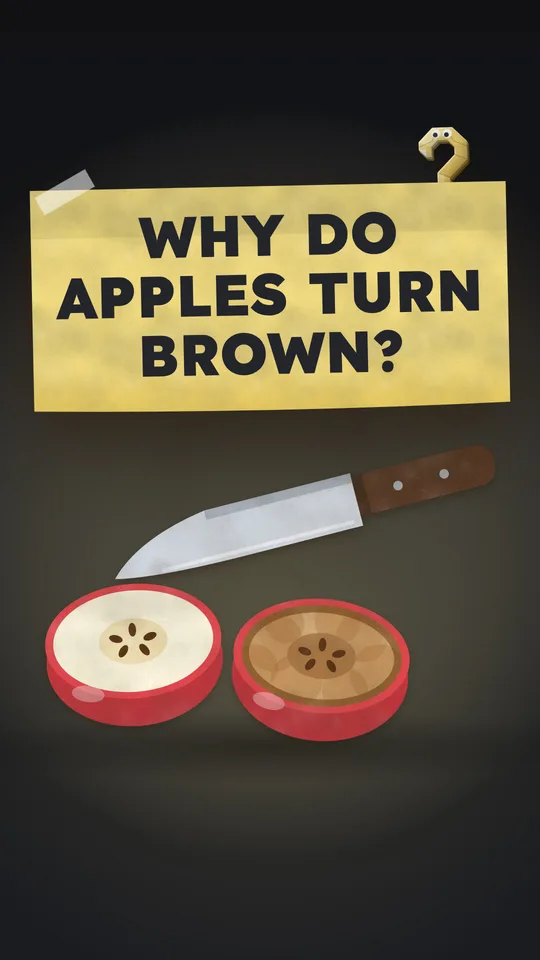
Cutting an apple breaks open its cells, so an enzyme that is normally kept apart from the fruit's phenolic compounds meets them and uses oxygen from the air to turn them into brown pigments. It is not rust: there is hardly any iron involved, and the enzyme runs on copper.
It isn't rust
Some popular explanations say a cut apple turns brown because it is rusting like a piece of metal, but the brown colour is not iron oxide, the material rust is made of1. There is very little iron to rust in the first place: US government food data list about 0.12 milligrams of iron per 100 grams of raw apple with skin2, and Health Canada's nutrient tables give 0.2 milligrams for a whole medium apple of 138 grams17. The enzyme behind browning does carry metal, but it is copper: its active centre holds two copper ions5, and copper is essential for it to work7.
Two ingredients kept apart
Apple cells contain an enzyme called polyphenol oxidase, or PPO. In apples it sits in plastids, small compartments that include the chloroplasts5. Its raw materials are colourless phenolic compounds such as chlorogenic acid and catechin. They are stored mostly in the vacuole, the cell's storage sac, behind an intact membrane, so in a healthy cell the two do not touch4, 6.
Cutting or bruising tears cells open and lets oxygen into the damaged tissue3. Now enzyme and phenolics can meet4, and PPO uses oxygen to turn the phenolics into reactive molecules called o-quinones3, 7. These then react with proteins or with each other, without further help from the enzyme, and build brown pigments known as melanins3, 7. Researchers point out that these later, non-enzymatic steps have been studied much less than the enzyme itself15.
How fast does it happen?
A university extension article says cut flesh can turn an unappealing brown within minutes of meeting the air8. Lab measurements show the change building up: in one study, the measured colour change of Golden Delicious slices rose from 2.38 to 4.05 during the first hour of air exposure at room temperature9.
Varieties differ, because enzyme activity and the amount of phenolics vary between them, and enzyme levels also change with growing conditions and ripeness3. In a camera-based study, Honeycrisp slices browned within two hours, while Golden Delicious barely browned over 14 hours10. Another study, however, found that Golden Delicious browned more than Elstar, and suggested that its higher chlorogenic acid content might explain this9.
What slows it down
Lemon juice works in two ways. It is acidic, and the lower pH makes PPO less active1, 3. It also contains antioxidants3: vitamin C (ascorbic acid) reacts with oxygen and turns o-quinones back into colourless phenolics. It only works until the vitamin C is used up, so the effect is temporary9. Extension services recommend dipping cut apples in water with dissolved vitamin C (ascorbic acid)8, 16.
Keeping oxygen away also helps: coating slices in sugar or syrup, as in jam, cuts down how much oxygen reaches them3, 12. A short soak in salted water slows browning as well8, although the sources we read do not explain exactly why. Cold makes a big difference: in one study, untreated apple cubes darkened sharply within 4 days at 22 °C, but only slightly over 12 days at 5 °C13. Boiling slices for a few minutes largely switches the enzyme off, but it also changes their texture3, 8.
Switching the enzyme off
The clearest proof that PPO is the culprit comes from genetics. Scientists created a genetically modified apple that carries an extra gene designed to silence at least four of the apple's own browning PPO genes, so its cells make no PPO protein or much less of it14. US regulators approved it in 201514; an extension article written before the approval already described its cut flesh as resisting browning8. Some conventional varieties are also considered naturally low-browning8.
What we're not sure about
Enzyme levels alone do not predict browning: a recent review reports that in a comparison of 14 apple varieties, one variety stayed highly prone to browning even though it had the lowest PPO activity11.
The later, non-enzymatic reactions that build the brown pigments are much less understood than the enzyme step15.
What PPO is actually for in the living plant is still uncertain; it seems to have more than one function4, 5.
Sources disagree on which varieties brown least: one names Granny Smith as naturally low-browning8, while a camera-based study saw Granny Smith brown within about two hours and Golden Delicious barely brown at all10. A third study found Golden Delicious browning more than another variety9. Different measuring methods may explain part of this.
Salt water slows browning8, but the sources we could read do not explain the mechanism.
Cold slows browning of cut slices13, yet very long cold storage of whole apples has been linked to a different problem, browning inside the flesh6.
We found no survey showing how many people actually believe the 'rust' explanation; we only know it appears in popular explanations1.
Sources
- Science World (Canada): Ever Wonder About Apples Going Brown? Science World, 2015 (web article)
- USDA Agricultural Research Service: FoodData Central, SR Legacy, Apples, raw, with skin (FDC ID 171688), iron 0.12 mg per 100 g
- McLandsborough L: Why do apple slices turn brown after being cut? Scientific American, 2007 (expert answer)
- Padiglia A, Zucca P, Cannea FB, et al.: Absence of Polyphenol Oxidase in Cynomorium coccineum, a Widespread Holoparasitic Plant. Plants (Basel), 2020 (PMC full text)
- Zhang S: Recent Advances of Polyphenol Oxidases in Plants. Molecules, 2023 (PMC full text)
- Wang J, Li F, Li B, et al.: ROS-mediated membrane damage and antioxidant imbalance drive apple flesh browning during cold storage. Frontiers in Plant Science, 2025 (PMC full text)
- Cui G, Peng J, Liu P, et al.: Ethyl 3-mercaptopropionate, a safe food flavoring, competitively inhibits polyphenol oxidase and prevents browning in fresh-cut produce. Food Chemistry: X, 2025 (PMC full text; background section only)
- Warmund M: A Fresh Approach to Non-browning Apples. University of Missouri Integrated Pest Management, Missouri Environment & Garden, 2009 (revised 2012) (extension article)
- Shrestha L, Kulig B, Moscetti R, et al.: Optimisation of Physical and Chemical Treatments to Control Browning Development and Enzymatic Activity on Fresh-cut Apple Slices. Foods, 2020 (PMC full text)
- Subhashree SN, Sunoj S, Xue J, Bora GC: Quantification of browning in apples using colour and textural features by image analysis. Food Quality and Safety, 2017 (open-access full text)
- Zhu Z, Yuan X, Xu S, et al.: Early signaling events as vital regulators of enzymatic browning in fresh-cut fruits and vegetables: a mini-review. Frontiers in Plant Science, 2026 (PMC full text)
- Institute of Food Science and Technology (IFST): Fruit and vegetables: enzymic browning. Love Food Love Science resources (food-science institution teaching page)
- Shyu YS, Chen GW, Chiang SC, Sung WC: Effect of Chitosan and Fish Gelatin Coatings on Preventing the Deterioration and Preserving the Quality of Fresh-Cut Apples. Molecules, 2019 (PMC full text; control-sample data used)
- Waltz E: Nonbrowning GM apple cleared for market. Nature Biotechnology news, Trade Secrets blog, 2015 (science news)
- Tilley A, et al.: Enzymatic browning: The role of substrates in polyphenol oxidase mediated browning. Current Research in Food Science, 2023 (abstract, via Future Food Systems CRC page)
- Penn State Extension: Preserving the Amazing Apple. Penn State Extension (extension article)
- Health Canada: Nutrient Value of Some Common Foods (2008), Table 5 Fruit and fruit juices, apple with skin (7 cm diam., 138 g): iron 0.2 mg
Researched and independently fact-checked on 16 November 2026. Found a mistake? Tell us at querigami@gmail.com and we will correct it here.
Even careful research can contain errors, and science keeps moving. This article is for general information and education only, not professional advice. We link to sources so you can check them yourself, but we are not responsible for the content of external websites.