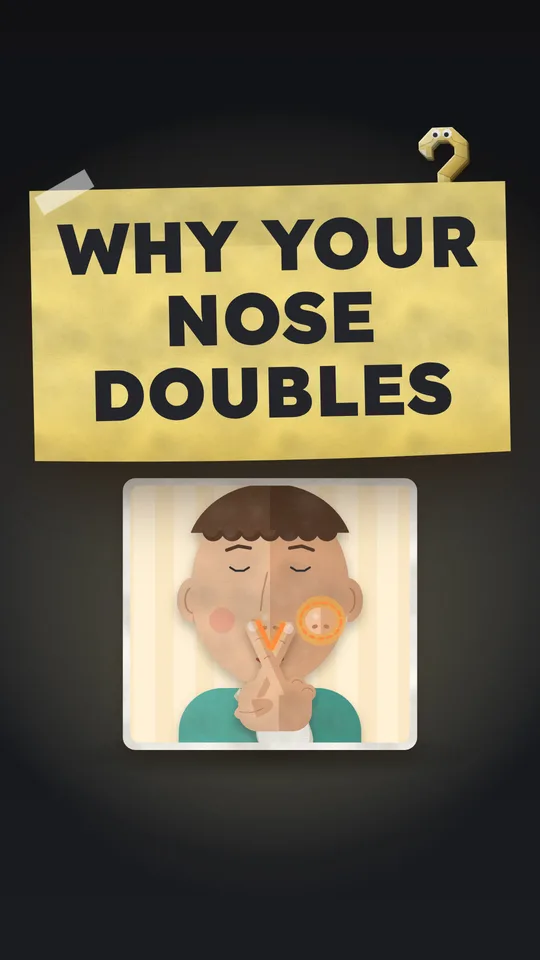
Cross two fingers, touch the tip of your nose, and many people feel two noses. It's a puzzle Aristotle wrote about, and it shows how your brain guesses where your fingers are.
A trick Aristotle wrote down
Cross your middle finger over your index finger, close your eyes, and roll a small ball, such as a marble or a pea, in the gap between the two fingertips. Many people feel two balls instead of one3, 7. It's called Aristotle's illusion because the Greek philosopher described it more than 2,300 years ago3.
In his short work On Dreams he wrote that with crossed fingers, one object between them 'is felt [...] as two; but yet we deny that it is two; for sight is more authoritative than touch'1. He mentions it again in the Metaphysics: touch says there are two objects, while sight says there is one2.
Your brain assumes your fingers are in their usual place
When your fingers are side by side, the thumb side of your index finger and the ring-finger side of your middle finger face away from each other. Touching both of those outer sides at the same moment usually only happens when two separate things touch them3, 7. Cross your fingers, and a single object lands on exactly those two outer sides3. The touched skin patches aren't neighbours, and their signals normally go to separate spots in the brain's map of touch9. The brain seems to read the touches as if the fingers were still uncrossed, so it reports two objects7, 8.
In the 1980s, Fabrizio Benedetti mapped where people felt touches on crossed fingers. He concluded that 'tactile stimuli are always perceived as if fingers were uncrossed'4.
How strong is it, and can you unlearn it?
In the lab the effect is very reliable. In one study of 30 blindfolded adults (half of them with Parkinson's disease, with no difference between the groups), one small ball on crossed fingers was felt as two in about 93 percent of trials, versus about 17 percent with the fingers side by side8. In another small study, all 14 participants felt two spheres with crossed fingers, including five people born blind7. The authors took this as a sign that the illusion doesn't depend on growing up with sight7.
Unlearning it takes patience. In a training study, six volunteers kept two fingers crossed for up to six months, and only after a variable period did they start to get the positions right6. Later researchers describe that training as several hours a day, for months10.
Try it yourself
Cross your middle finger over your index finger. Close your eyes and gently stroke the tip of your nose with the gap between the two fingertips. Do you feel two noses? Then open your eyes and watch your fingers. Guides say the effect is clearer with your eyes closed3, and an explainer for young readers says that when you look, vision usually wins12. The nose version is described in a research review and in Scientific American, but we found no study that measured it14, 15.
Now try it the other way round. Keep your fingers crossed and your eyes closed, and ask someone to touch the two sides that now face outwards (the sides that normally touch each other) with two pencils at the same moment. In 1894, W. H. R. Rivers reported that more than half of the people he tested felt just one rod13.
What we're not sure about
Why doesn't the brain just use what it knows about the crossed position? Benedetti found that touch is mapped as if the fingers were uncrossed4. A 2025 brain-scan team suggests the illusion may come from how skin signals are combined with signals about finger position11. In a task where people judged the direction of two taps, crossed fingers usually made them answer the wrong way round, though not always. The authors suggest that how much the brain uses the crossed position may depend on the task and on what people can see10.
Does looking really weaken the feeling? We found advice and explanations3, 12 but no controlled study comparing eyes open with eyes closed. Aristotle wrote that touch still says two while we decide it is one1, which hints that seeing may change our judgment more than the feeling itself.
Studies use small balls a few millimetres across8, 11. The nose version is described in a review and in Scientific American14, 15, but we found no study that tested the nose itself.
Where in the brain does it happen? Brain scans point to touch areas and to the parietal lobes11, but the model told the two illusions apart only about 68 percent of the time, in a small group, which the authors themselves flag as limits11.
Sources
- Aristotle (c. 350 BC): On Dreams, Part 2, trans. J. I. Beare. MIT Internet Classics Archive
- Aristotle (c. 350 BC): Metaphysics, Book IV, Part 6, trans. W. D. Ross. MIT Internet Classics Archive
- Baysan, U. & Macpherson, F. (2017): Aristotle's Illusion. In F. Macpherson (ed.), The Illusions Index
- Benedetti, F. (1985): Processing of tactile spatial information with crossed fingers. Journal of Experimental Psychology: Human Perception and Performance 11(4), 517-525 (abstract via Europe PMC, PMID 3161990)
- Benedetti, F. (1986): Tactile diplopia (diplesthesia) on the human fingers. Perception 15(1), 83-91 (abstract via Europe PMC, PMID 3774481)
- Benedetti, F. (1991): Perceptual learning following a long-lasting tactile reversal. Journal of Experimental Psychology: Human Perception and Performance 17(1), 267-277 (abstract via Europe PMC, PMID 1826316)
- Nava, E., Steiger, T. & Röder, B. (2014): Both developmental and adult vision shape body representations. Scientific Reports 4, 6622
- Fiorio, M., Marotta, A., Ottaviani, S., Pozzer, L. & Tinazzi, M. (2014): Aristotle's Illusion in Parkinson's Disease: Evidence for Normal Interdigit Tactile Perception. PLOS ONE 9(2), e88686
- Tinazzi, M., Marotta, A., Fasano, A. et al. (2013): Aristotle's illusion reveals interdigit functional somatosensory alterations in focal hand dystonia. Brain 136(3), 782-789
- de Haan, A. M., Anema, H. A. & Dijkerman, H. C. (2012): Fingers Crossed! An Investigation of Somatotopic Representations Using Spatial Directional Judgements. PLOS ONE 7(9), e45408
- Lee, E., Kim, J.-H. et al. (2025): Neural decoding of Aristotle tactile illusion using deep learning-based fMRI classification. Frontiers in Neuroscience
- Augenstein, R., Collett, K., Mehra, K. & Hegdé, J. (2023): Seeing With Your Tongue? How The Brain Uses Multiple Senses At Once. Frontiers for Young Minds 11, 995397
- Rivers, W. H. R. (1894): A Modification of Aristotle's Experiment. Mind, New Series 3(12), 583-584 (Wikisource)
- Hayward, V. (2008): A brief taxonomy of tactile illusions and demonstrations that can be done in a hardware store. Brain Research Bulletin 75(6), 742-752
- Rogers-Ramachandran, D. & Ramachandran, V. S. (2008): Touching illusions. Scientific American, May 2008
Researched and independently fact-checked on 21 November 2026. Found a mistake? Tell us at querigami@gmail.com and we will correct it here.
Even careful research can contain errors, and science keeps moving. This article is for general information and education only, not professional advice. We link to sources so you can check them yourself, but we are not responsible for the content of external websites.