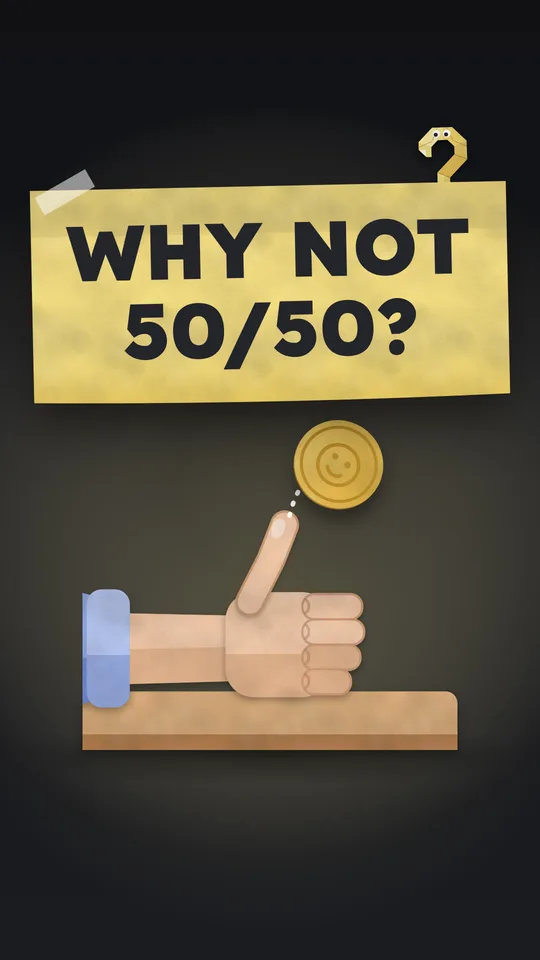
A coin you flip and catch lands on the side it started on slightly more than half the time: 50.8 percent in a study of 350,757 flips1. The leading explanation: a wobble in flight keeps the starting side up a little longer2, 5. Overall, heads and tails still come up equally often1.
Physics, not luck
A coin flip is the textbook picture of pure chance1. Yet a tossed coin follows the ordinary laws of mechanics, so its flight is settled the moment it leaves your thumb2.
Stanford statistician Persi Diaconis and his colleagues showed this with a coin-tossing machine: a spring, released by a ratchet, flips the coin into a cup2. Carefully adjusted, it made a coin that started heads up land heads up one hundred percent of the time2. With human flippers, the randomness comes from small differences in height, speed and catch from one flip to the next3.
The wobble that remembers
One perfectly fair way to flip a coin is to make it spin end over end around a level axis4. Real flips rarely manage that: the axis is tilted, and the coin wobbles like a spinning top, which physicists call precession2, 4.
Picture an arrow sticking straight out of the starting face. In flight, that arrow sweeps around in a circle, and for almost every tilt, more of that circle points up than down2. So the coin spends a little more of its time in the air with the starting side on top5. If the tilt is strong enough, it never turns over at all and only wobbles, which can look surprisingly like a real flip2, 4.
Counting the flips
To measure the tilt, Diaconis’ team filmed flips with a high-speed camera at about 600 frames per second2. From 27 usable flips, they estimated that a coin lands the way it started about 51 percent of the time2.
Checking that by hand takes patience. Two Berkeley students flipped coins 40,000 times in 2009 and got an ambiguous result6. Later, 48 people led by František Bartoš at the University of Amsterdam5 flipped 44 kinds of coins 350,757 times, catching each one in the hand1. Of those, 178,079 landed on their starting side: 50.8 percent, with a 95 percent credible interval of 50.6 to 50.9 percent1. The work won the 2024 Ig Nobel Prize in Probability7 and was published in the Journal of the American Statistical Association in 20251.
Heads and tails still tie
The bias is about the starting side, not about heads. Overall, the coins landed heads 50.0 percent of the time, and no coin type stood out1. If the starting side is itself random, the outcome stays random too2.
The effect is also tiny. Diaconis estimated that a casual observer would need about 10,000 tosses to notice it4, and his team calculated that pinning it down to a tenth of a percent would take about 250,0002.
It depends on the flipper
Not everyone wobbles equally. Individual same-side rates ranged from about 49 to 60 percent, and some people showed little or no bias1. For most flippers the bias shrank with practice, and the authors suggest that around 10,000 flips might nearly erase it1.
The physics model also assumes that the coin is caught. Slapping it onto the back of your hand turns it over once more and reverses the bias2. Spinning a coin on a table is a different game: Diaconis has said a spinning penny lands tails about 80 percent of the time4.
What we’re not sure about
Why people differ: practice is one explanation, but the researchers cannot rule out tiredness or waning attention1.
The flippers knew what was being tested. Their videos showed nothing suspicious, but the authors say a study that hides its aim is needed to rule it out conclusively1.
Coins that bounce on the floor are poorly studied. Diaconis’ team suspects they may be even less fair than caught coins, but that is a conjecture2.
The original high-speed measurements used a small number of carefully staged flips, which may differ from vigorous everyday tosses2.
Spun coins depend delicately on the edge and centre of gravity, so the 80 percent figure is no general rule2, 4.
Sources
- Bartoš, F., Sarafoglou, A., Godmann, H. R., … Wagenmakers, E.-J. (2025): Fair Coins Tend to Land on the Same Side They Started: Evidence from 350,757 Flips. Journal of the American Statistical Association 120(552), 2118–2127 (open version: arXiv:2310.04153v4, 17 Apr 2025)
- Diaconis, P., Holmes, S., Montgomery, R. (2007): Dynamical Bias in the Coin Toss. SIAM Review 49(2), 211–235
- Kestenbaum, D. (2004): The Not So Random Coin Toss. NPR, All Things Considered, 24 Feb 2004
- Klarreich, E. (2004): Toss Out the Toss-Up: Bias in heads-or-tails. Science News, 25 Feb 2004
- Kim, S. E. (2024): Scientists Destroy Illusion That Coin Toss Flips Are 50–50. Scientific American, 1 Jan 2024 (print title “Heads or Tails?”, Vol. 330 No. 1)
- Aldous, D. (2009): 40,000 coin tosses yield ambiguous evidence for dynamical bias. University of California, Berkeley, Department of Statistics
- Improbable Research (2024): The 2024 Ig Nobel Prize Winners (Probability Prize). improbable.com, ceremony 12 Sep 2024
Researched and independently fact-checked on 11 November 2026. Found a mistake? Tell us at querigami@gmail.com and we will correct it here.
Even careful research can contain errors, and science keeps moving. This article is for general information and education only, not professional advice. We link to sources so you can check them yourself, but we are not responsible for the content of external websites.