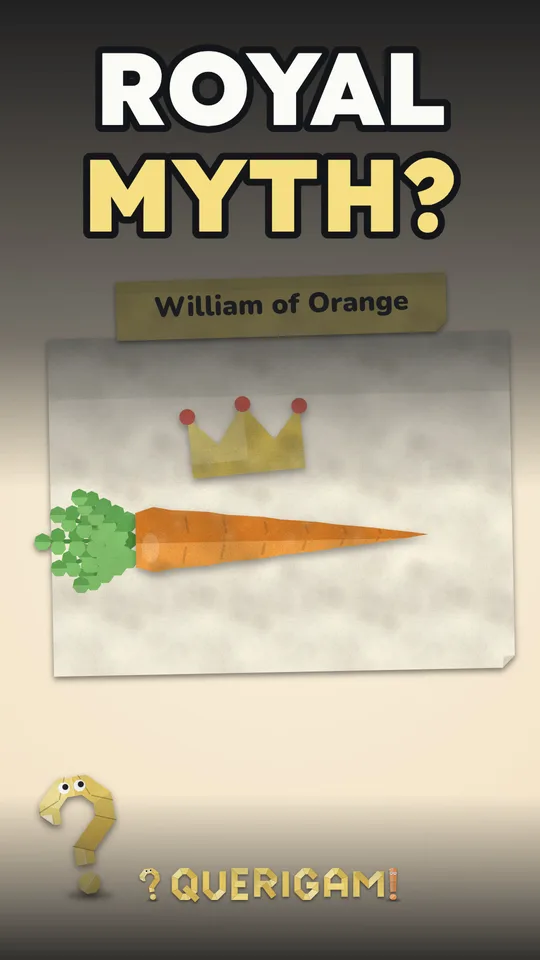
Carrots are orange because farmers selected them that way. Wild carrots have white or pale yellow roots, the first farmed carrots were purple or yellow, and orange carrots were probably selected from yellow ones in western Europe during the Renaissance1, 2. The colour comes from alpha- and beta-carotene, which build up when a carrot carries the recessive versions of three genes2. The popular story that Dutch farmers bred them to honour William of Orange has no documentary evidence behind it6.
Your carrot used to be a different colour
Pick up a carrot in your kitchen and it is almost certainly orange. But wild carrot, the roadside plant also known as Queen Anne's lace, has slender roots that are white or pale yellow and have an unpleasant, sharp taste1.
When people began farming carrots, the first crops were purple or yellow1, 2. A large genetic study of 630 carrot samples, wild and cultivated, suggests this happened in the Early Middle Ages, somewhere between western and central Asia2. Purple carrots get their colour from pigments called anthocyanins, which turn brown when cooked and stain hands and pots1.
How orange took over
Purple and yellow carrots spread west. Between the twelfth and fifteenth centuries they were eaten in Spain, Italy, France, Germany, England and the Netherlands2. In Europe the yellow ones became more popular, likely because of their taste3.
Then came orange. The genetic study concludes that orange carrots were selected during the Renaissance, probably in western Europe2. In its family tree, yellow carrots from the Netherlands (and Poland) sit at the base of all western orange carrots. That supports an old idea of a Dutch, or perhaps Belgian, origin2. One idea is that orange carrots came from crossing white and yellow ones3.
Dutch growers shaped the result. 'Horn' carrots, named after the town of Hoorn, were developed in Holland1. By 1763 carrots were sorted into four types: 'Long Orange' and three Horn carrots. Modern western orange carrots descend from these four1.
The chemistry of orange
The orange colour comes from alpha- and beta-carotene, pigments that orange carrots store in large amounts2. Surprisingly, getting there meant switching genes off. Deep orange needs the recessive versions of three genes at once; each was selected separately and then became fixed2, 3.
One of them, called Or, carries a small change that was missing in every wild carrot sample studied but is nearly universal in orange cultivated carrots4. A candidate for a further colour gene, called Y (not one of the three above), turned up in 2016, when researchers published the first carrot genome sequence3, 5.
So, what about William of Orange?
A popular story says Dutch farmers bred orange carrots to honour William of Orange, a leader of the Dutch Revolt, which began in 15666. John Stolarczyk, curator of the online World Carrot Museum, says there is no documentary evidence that the Dutch invented orange carrots to honour their royal family6.
What does fit: the orange carrot does seem to have been developed and stabilised in the Netherlands around that time, and it grew very well in the Dutch climate6. But orange carrots were not only Dutch. An orange carrot appears next to a purple root in ceiling decorations in a villa in Rome, made between 1515 and 1517 (the picture caption says 1518)1. Later, the Dutch state may have used orange carrots to underline its national colour, and that may be where the royal link comes from6.
Stolarczyk calls the story simply not true; in his account the orange carrot came first and the independent Dutch state second6. And the old colours never fully vanished. Purple and yellow carrots are making a comeback, and many shops sell mixed 'rainbow' bags of red, yellow, white, purple and orange carrots1.
What we're not sure about
When carrots were first farmed: a 2011 history says almost five thousand years ago on the Iranian Plateau1, while a 2023 genome study places domestication between the sixth and tenth centuries2.
When orange appeared: the same genome study says orange carrots were selected in the 1500s but also that the orange group first appeared in Europe in the seventeenth century2, and its press release says about the 15th or 16th century3.
Old pictures are hard to read: a herbal illustrated in 512 shows what historians describe as a deeply orange cultivated carrot1, which is hard to fit with the genetic timeline, and carrots and parsnips were often confused in old sources1.
Where orange came from: from mutations of yellow carrots1, from crosses of white and yellow ones3, and the study cannot rule out an ancestor population that was never sampled or has died out2.
Sources
- Stolarczyk, J. & Janick, J. (2011): Carrot: History and Iconography. Chronica Horticulturae 51(2): 13-18. International Society for Horticultural Science
- Coe, K., Bostan, H., Rolling, W. et al. (2023): Population genomics identifies genetic signatures of carrot domestication and improvement and uncovers the origin of high-carotenoid orange carrots. Nature Plants 9(10): 1643-1658 (doi 10.1038/s41477-023-01526-6)
- Kulikowski, M. (2023): What Makes a Carrot Orange? Genome Study Offers Answers to Questions About Pigmentation, Domestication. NC State University News, 28 September 2023
- Ellison, S. L., Luby, C. H., Corak, K. E. et al. (2018): Carotenoid Presence Is Associated with the Or Gene in Domesticated Carrot. Genetics 210(4): 1497-1508 (doi 10.1534/genetics.118.301299)
- Iorizzo, M., Ellison, S., Senalik, D. et al. (2016): A high-quality carrot genome assembly provides new insights into carotenoid accumulation and asterid genome evolution. Nature Genetics 48(6): 657-666 (doi 10.1038/ng.3565)
- Plackett, B. (2020): Are carrots orange because of a Dutch revolutionary? Live Science, 5 September 2020
Researched and independently fact-checked on 2 November 2026. Found a mistake? Tell us at querigami@gmail.com and we will correct it here.
Even careful research can contain errors, and science keeps moving. This article is for general information and education only, not professional advice. We link to sources so you can check them yourself, but we are not responsible for the content of external websites.