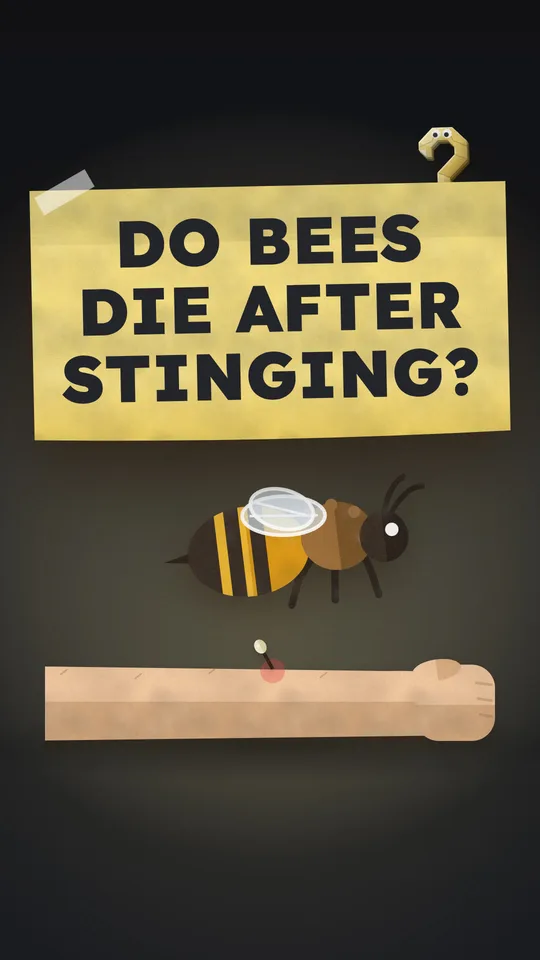
Yes, if it is a honeybee worker that stings you: her sting usually stays in your skin, and she dies hours or even days later2, 10. But honeybees are only about eight of almost 21,000 bee species, and most other bees, wasps and even honeybee queens can sting more than once7, 8, 9.
Only a few bees pay with their lives
The popular saying is only partly right: of almost 21,000 bee species in the world, only eight die when they sting, and those eight are honeybees8.
The majority of bees can sting as often as they want, and around 500 species cannot sting at all8, 9.
Even in a honeybee colony, it is the workers that die: a queen can sting several times7, 9.
Barbs that work like fish hooks
A worker's sting has two thin blades called lancets, and each carries about ten backward-pointing barbs1, 4.
In honeybees these barbs lie fully exposed, while in yellowjackets and other wasps they are tucked away, which probably makes a honeybee sting harder to pull back out6.
Mammal skin is elastic, so the barbs catch in it and the sting stays in the wound1, 2.
When the bee pulls away, the sting is torn out of her abdomen together with its venom sac and muscles1, 2, 3.
A sting that keeps on working
The torn-off sting carries its own muscles and a small nerve centre, so it keeps stinging for a short time without the bee1.
In a lab study with European honeybees, at least 90% of the venom sac's contents were delivered within 20 seconds, and delivery was complete within one minute5.
The sting also gives off an alarm signal whose main ingredient, isopentyl acetate, has a banana-like smell, and this signal helps recruit more defenders1, 2.
Not instant, and not against everyone
A bee that has lost her sting does not die straight away: a short 1951 report, cited in a 2016 review, found that she lives 18 to 114 hours2; a 2023 anatomy paper repeats this range from that review1.
Researchers link sting autotomy to vertebrate attackers, such as mammals1, 2.
Against other insects the picture is less clear. The barbed sting probably evolved for stinging other bees and insects9, and researchers tie sting autotomy to vertebrate attackers1, 2. When honeybee guards fight robber bees from another colony, each tries to sting the other, and the bee that gets stung dies2; what happens to the bee that stings is not described.
A worker can sometimes free a stuck sting by turning her body around the sting site, but it is hard work1.
Only females carry a sting
The sting began as an egg-laying tube, so only females have one1, 7.
Male bees of every species have no sting at all7, 8.
Bumblebee stings lack barbs9, 10 and wasp barbs are small10, so both can sting again and again10.
What we're not sure about
How long a bee lives after losing her sting is reported very differently: 18 to 114 hours in a review2, but 'a few minutes' in a popular magazine9.
That honeybees can often survive stinging other insects is widely repeated and fits the idea that the barbs evolved for insect fights9, but we found no study that measured it directly.
How often a worker manages to twist her sting free from skin is not known1.
Species counts vary between sources: about 20,000 or almost 21,000 bee species, and about 500 or 537 stingless ones8, 9.
Wasps are not always safe: some yellowjackets lose their sting surprisingly often in clinical sting tests, though less often in the wild6.
Sources
- Ramirez-Esquivel F., Ravi S.: Functional anatomy of the worker honeybee stinger (Apis mellifera), iScience 2023 (peer-reviewed paper)
- Nouvian M., Reinhard J., Giurfa M.: The defensive response of the honeybee Apis mellifera, Journal of Experimental Biology 2016 (peer-reviewed review)
- Zhao Z.-L. et al.: Structures, properties, and functions of the stings of honey bees and paper wasps: a comparative study, Biology Open 2015 (peer-reviewed paper)
- Wu J., Yan S., Zhao J., Ye Y.: Barbs Facilitate the Helical Penetration of Honeybee (Apis mellifera ligustica) Stingers, PLOS ONE 2014 (peer-reviewed paper)
- Schumacher M.J., Tveten M.S., Egen N.B.: Rate and quantity of delivery of venom from honeybee stings, J Allergy Clin Immunol 1994 (peer-reviewed paper)
- Mulfinger L. et al.: Sting morphology and frequency of sting autotomy among medically important vespids and the honey bee, Journal of Medical Entomology 1992 (peer-reviewed paper)
- UC Agriculture and Natural Resources, Bug Squad (quoting UC Davis apiculturist Eric Mussen): The Sting, 2008 (university blog)
- Dorey J.B., Gilpin A.-M., Gloag R.: Most bees don't die after stinging - and other surprising bee facts, The Conversation 2024 (republished by University of Wollongong)
- Caird J.: Why does a bee die after it stings you? And is that the case for all bees?, Discover Wildlife (BBC Wildlife), page dated 10 July 2026 (science magazine)
- Washington State Department of Health: Bees and Wasps (public health information page)
Researched and independently fact-checked on 16 November 2026. Found a mistake? Tell us at querigami@gmail.com and we will correct it here.
Even careful research can contain errors, and science keeps moving. This article is for general information and education only, not professional advice. We link to sources so you can check them yourself, but we are not responsible for the content of external websites.